Thiadiazole tert-dodecyl mercaptan condensate CAS: 59656-20-1
CSAIL T561 is an ashless thiadiazole metal deactivator with excellent anti-active-sulfur corrosion and antioxidant synergistic properties.
Read More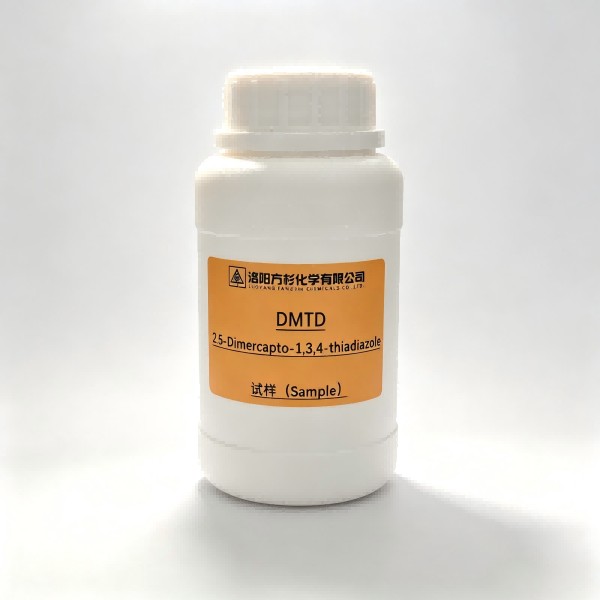
2,5-Dimercapto-1,3,4-thiadiazole DMTD is an advanced solid organic molybdenum extreme pressure anti-wear agent that ensures excellent antioxidant and anti-wear properties in greases and lubricants. It can serve as a complete or partial replacement for molybdenum disulfide.
Product name: DMTD
Similar products: VANCHEM DMTD
Chemical name: 2,5-Dimercapto-1,3,4-thiadiazole
Appearance: Light yellow to yellow powder
Active substance content (%): 98.0
Drying loss (80℃/2h): 0.1
Fusion point (℃) : 161
Ignition residue (%): 0.3
DMTD (2,5‑dimercapto‑1,3,4‑thiadiazole) is an important chemical intermediate. Its derivatives are widely used in medicine, lubricating grease, metalworking fluid, rubber industry, etc. Chemical reactions generally include: double decomposition reaction with soluble salts, salt forming reaction with alkali metal hydroxide, oxidation reaction of sulfydryl group, addition reaction with organic compounds containing active double bonds, reaction with oxygen containing groups, reaction with aldehyde and alcohol, salt forming reaction with amine and ammonia, and reaction with acyl chloride.
Small particle size: Characterized by small particle size for easy handling and reaction.
Less odor & high purity: Features less odor and high purity (98.0%).
Contains no metals: Metal‑free composition.
Versatile chemical intermediate: Serves as an important chemical intermediate and raw material for diverse derivative synthesis.
Chemical intermediate: Acts as a key building block for synthesizing a wide range of derivatives.
Reactive versatility: Participates in various chemical reactions, including double decomposition, salt formation, oxidation, addition, reaction with oxygen‑containing groups, aldehyde/alcohol, amine/ammonia and acyl chloride reactions.
Wide downstream applications: Its derivatives are widely applied in medicine, lubricating grease, metalworking fluid and rubber industry.
An important chemical intermediate and raw material used to produce thiadiazole‑based derivatives.
Its derivatives are widely used in medicine, lubricating grease, metalworking fluid, rubber industry, etc.
The price of DMTD changes based on product grade, order volume and the supplier's pricing policy. To obtain accurate quotation details, kindly reach out to a trusted supplier or manufacturer directly. When assessing total costs, take note of its prominent advantages: DMTD offers high purity and reactive versatility as a key chemical intermediate, supporting efficient derivative synthesis and downstream application performance.
If you are sourcing DMTD or would like to acquire further technical data, please do not hesitate to contact FansChem.
Q1: What is DMTD and its main chemical composition?
A: DMTD (2,5‑dimercapto‑1,3,4‑thiadiazole) is an important chemical intermediate, CAS No.: 1072‑71‑5.
Q2: What are the key physical‑chemical properties of DMTD?
A: It is light‑yellow to yellow powder. Typical data: purity 98.0%, loss on drying at 80℃/2h 0.1%, melting point 161.0℃, residue on ignition 0.3%. Refer to the official TDS for complete index information.
Q3: What benefits does DMTD bring and how is it used?
A: It provides high purity, less odor, small particle size and metal‑free composition, serving as a versatile chemical intermediate and raw material. Compatibility / reaction suitability test is strongly required before use in specific formulations.
Q4: What end‑use products is DMTD suitable for?
A: Its derivatives are widely used in medicine, lubricating grease, metalworking fluid, rubber industry, etc.
Q5: What are packaging and storage requirements for DMTD?
A: Standard packaging is 40kg/drum (net weight). Store in a cool, dry and well‑ventilated warehouse.
Q6: What handling safety notes should I follow and where can I get TDS / SDS or quotation?
A: Avoid direct contact with skin, eyes and clothing. Follow standard industrial hygiene practices; always refer to the official SDS/MSDS for full safety guidance. For complete TDS, SDS or commercial quotation, please contact FansChem technical‑sales team directly.
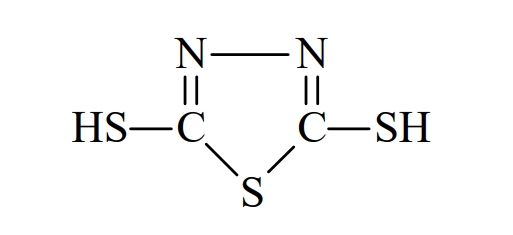
Chemical property of 2,5-Dimercapto-1,3,4-thiadiazole DMTD:
Description | 2,5-Dimercapto-1,3,4-thiadiazole DMTD is an important chemical intermediate. Its derivatives are widely used in medicine, lubricating grease, metalworking fluid, rubber industry, etc. Chemical reactions generally include: double decomposition reaction with soluble salts, salt forming reaction with alkali metal hydroxide, oxidation reaction of sulfydryl group, addition reaction with organic compounds containing active double bonds, reaction with oxygen containing groups, reaction with aldehyde and alcohol, salt forming reaction with amine and ammonia, and reaction with acyl chloride. |
Chemical name | 2,5-Dimercapto-1,3,4-thiadiazole |
Chemical structure |
|
CAS No. | 1072-71-5 |
Highlights | Small particle size; less odor; high purity. |
Technical parameters of 2,5-Dimercapto-1,3,4-thiadiazole DMTD:
Item | Specification |
Appearance | Light yellow to yellow powder |
Active substance content (%) | 98.0 |
Drying loss (80℃/2h) | 0.1 |
Fusion point (℃) | 161 |
Ignition residue (%) | 0.3 |
Packaging | 50kgs / Kraft paper (Net weight) |
Relative products | VANCHEM DMTD |
Storage information | For more information, please refer to the relevant MSDS. |
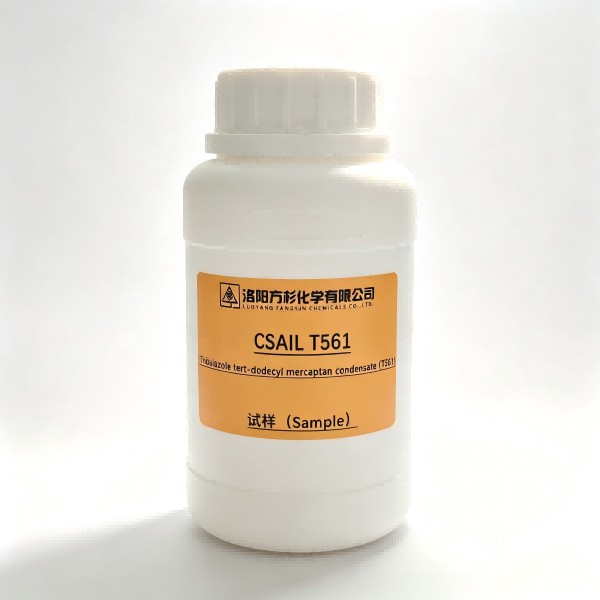
CSAIL T561 is an ashless thiadiazole metal deactivator with excellent anti-active-sulfur corrosion and antioxidant synergistic properties.
Read More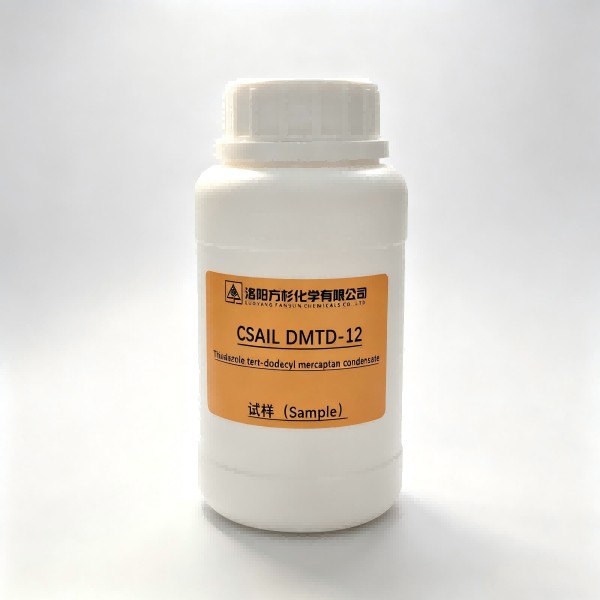
CSAIL DMTD-12 is an ashless thiadiazole metal deactivator with outstanding copper corrosion inhibition and antioxidant synergistic properties.
Read More
2,5-Dimercapto-1,3,4-thiadiazole DMTD is an important chemical intermediate. Its derivatives are widely used in medicine, lubricating grease, metalworking fluid, rubber industry, etc.
Read More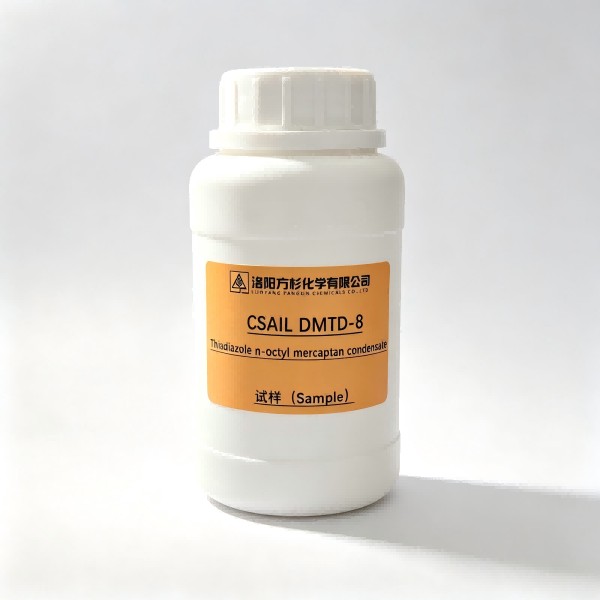
Thiadiazole octyl mercaptan condensate DMTD-8 with CAS 13539-13-4, is an effective additive for various applications due to its corrosion inhibition, metal deactivation, and anti-wear properties.
Read More WhatsApp
 Email
Email
 +8616638861155