Prevent Oxidation of 2,5-Dimercapto-1,3,4-thiadiazole (DMTD) in Aqueous Systems
Why does a water-based fluid containing 2,5-Dimercapto-1,3,4-thiadiazole (DMTD) darken, lose clarity, or show weaker corrosion control after blending or storage? In most cases, the answer is not simply “the additive oxidized.” The actual cause may involve pH drift, air entrainment, dissolved metal contamination, poor storage discipline, or an incompatible component already present in the formulation.
For formulators using thiadiazole chemistry as a metal deactivator, color change is an early warning sign rather than a cosmetic issue. A darker liquid, haze, sediment, or an unusual odor can indicate that the active sulfur-containing structure is changing. When that occurs, metal surface protection can become less predictable, and corrosion performance loss may appear during storage, circulation, or field use.
This guide provides a diagnosis order for aqueous DMTD systems, explains what each symptom can mean, and outlines practical corrective actions that can be assessed in a controlled formulation trial.
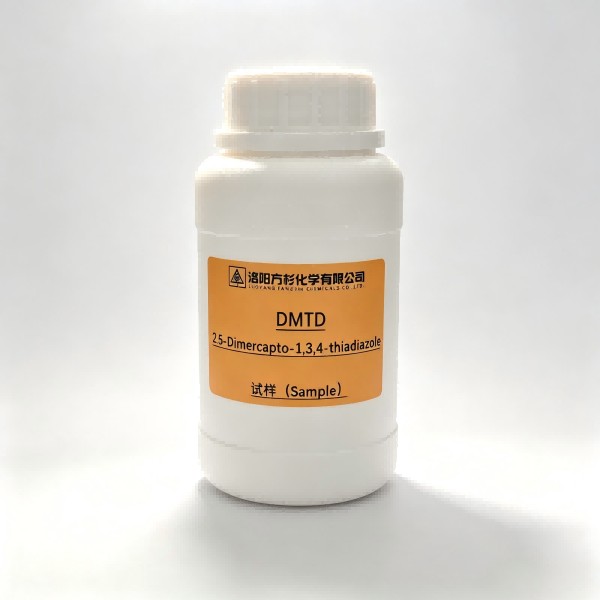
Start with symptom separation before changing the formulation
Conclusion: Do not add more metal deactivator as the first response to discoloration. First separate a true chemical stability issue from a physical appearance issue. Adding more active material to an unstable system can worsen color, sediment, odor, or compatibility problems.
The reason is straightforward. A water-based fluid can look darker because of oxidation, dissolved iron, copper pickup, insoluble salts, microbial activity, emulsion disturbance, or contamination from tanks and transfer lines. These causes require different remedies. A corrective action that helps one can make another worse.
This approach fits water based lubricants, water-based metalworking fluids, aqueous rust preventive concentrates, and diluted process fluids. It does not replace a full product qualification program where the finished fluid must meet customer-specific corrosion, friction, wear, or storage requirements.
| Observed symptom | Likely direction | First check | What the result suggests |
|---|---|---|---|
| Rapid yellow, amber, or brown color shift | Oxidation or metal interaction | Compare fresh retained sample with aged sample | A large visual difference points to chemical change or contamination during storage |
| Haze or suspended particles | Solubility loss or insoluble metal salts | Check pH and inspect filtered residue | Residue can indicate incompatibility, metal ion contamination, or pH-related precipitation |
| Dark sediment at tank bottom | Settling, corrosion debris, or reaction products | Inspect tank, transfer line, and make-up water source | Local contamination is more likely when fresh lab material remains clear |
| Corrosion failure without obvious color change | Active chemistry depletion or competitive surface adsorption | Compare treated and untreated test panels | The deactivator may be present but no longer working effectively in the full package |
| Foam and faster darkening after recirculation | Air entrainment | Review agitation, return-line design, and headspace exposure | Excess air contact can increase oxidation pressure on the aqueous system |
A practical first control is a retained reference sample. Keep a fresh sealed sample from each blend and compare it with material after storage or circulation. Use the same container type, fill level, and visual background. Without a retained reference, operators can notice that a fluid is dark but cannot determine whether the change started during blending, packaging, transport, or use.
Where the formulation uses related inhibitor chemistry, compare the full package rather than testing a single additive in isolation. Product selection may involve thiadiazole-based metal corrosion inhibitors with different solubility and compatibility behavior. A single-component screen is useful for diagnosis, but the finished fluid remains the decision point.
Check pH, dissolved oxygen, metal ions, and storage conditions in that order
Conclusion: Use a fixed diagnosis order: pH first, dissolved oxygen second, metal ions third, and storage conditions fourth. This order identifies the easiest-to-measure formulation shifts before moving to more complex contamination and handling investigations.
Each factor can contribute to discoloration and performance loss in aqueous DMTD systems. They also interact. For example, pH can change the solubility and reactivity of sulfur-containing chemistry; air can support oxidative reactions; metal ions can promote unwanted reactions; and poor storage can amplify all three.
| Diagnostic factor | What to examine | What a negative result points to | Corrective direction |
|---|---|---|---|
| pH | Fresh blend, aged sample, and in-use fluid | A noticeable shift from the approved blend condition suggests chemical imbalance, contamination, or depletion of buffering capacity | Identify the cause of drift before adjusting pH; then confirm clarity and corrosion behavior after correction |
| Dissolved oxygen | Air exposure, foaming, agitation, recirculation, and container headspace | Greater color change in aerated samples suggests oxygen-driven instability | Reduce air entrainment, limit unnecessary headspace, and use controlled mixing |
| Metal ions | Iron, copper, brass, and residues from tanks or process water | Darkening concentrated around contact surfaces suggests metal ion contamination or surface corrosion debris | Inspect equipment, water source, filtration practice, and compatibility of wetted parts |
| Storage conditions | Seal condition, repeated opening, temperature exposure, light exposure, and storage duration | Only stored packs changing while fresh material remains stable indicates handling or packaging exposure | Use clean sealed packaging and a defined stock rotation practice |
pH is the first formulation control point
pH affects the chemical form, solubility, and interaction behavior of thiol-containing materials in water. A pH movement can change how the metal deactivator behaves with co-additives, dissolved salts, amines, surfactants, corrosion inhibitors, and process water. It can also make an initially clear blend turn hazy or develop deposits.
Check pH immediately after blending, after a controlled storage period, and after the fluid has contacted process equipment. If the fresh and aged samples differ, do not assume that the metal deactivator is the only source. Review all recent formula changes, including water quality, neutralizing components, biocide additions, defoamer additions, and corrosion inhibitor changes.
This check fits any formula where an approved pH range already exists. It does not justify selecting a new pH target without compatibility testing. A pH adjustment can improve clarity while reducing corrosion control or destabilizing another additive component.
Dissolved oxygen and air exposure can speed visible degradation
Dissolved oxygen testing is especially useful when a fluid is stable in a sealed laboratory bottle but darkens after plant recirculation, high-shear mixing, or repeated drum opening. Foam, splashing, and a return line that drops into the tank can increase air contact. This does not prove oxidation by itself, but it is a strong process clue.
Set up a simple comparison trial using the same blend. Keep one sample tightly sealed with minimal headspace and expose another to the normal mixing or recirculation practice. Compare color, clarity, odor, pH, and corrosion screening results. If only the air-exposed sample shifts, focus first on handling and mixing rather than changing the additive dosage.
Reducing air contact is appropriate when oxidation is associated with circulation or storage exposure. It may not solve a system containing dissolved copper, iron contamination, or incompatible raw materials. Those issues require separate checks.
Metal ion contamination can change color and surface protection
Metal ion contamination is common in plant troubleshooting because aqueous fluids contact tanks, pumps, valves, transfer lines, drums, test panels, and production tools. Iron or copper residues can enter from corrosion products, poorly cleaned equipment, unsuitable water, or carryover from previous batches. The result may be darkening, haze, sediment, or inconsistent metal deactivator stability.
Check whether the issue appears only after contact with a particular vessel or line. Filter a discolored sample and inspect the residue. Compare a fresh laboratory blend made with clean containers and approved water against a plant sample made from the same raw materials. If the laboratory blend remains stable, the production environment becomes the priority investigation area.
Do not treat every dark fluid as a metal ion problem. If a sealed lab sample also changes color, the source may be formulation compatibility or oxidation during storage. The comparison between clean-lab and plant-contact samples provides a faster judgment than random additive changes.
Use a controlled troubleshooting procedure instead of trial and error
Conclusion: Change one variable at a time and retain samples from every stage. This produces usable evidence and prevents a temporary visual improvement from being mistaken for a permanent solution.
- Collect matched samples. Take a fresh blend sample, an aged retained sample, an in-use sample, and a sample after the suspected processing step. Use clean, clearly labeled containers.
- Record appearance before treatment. Note color, haze, sediment, foam, odor, and any phase separation. Photograph samples against the same background.
- Measure pH promptly. Compare the results with the approved fresh blend condition and identify whether the shift occurs before or after plant contact.
- Review oxygen exposure. Check mixer speed, circulation design, tank opening frequency, foaming, and storage headspace.
- Inspect for metal contact. Review tank cleanliness, line corrosion, filter residue, water source, and contact with copper or brass-containing equipment.
- Run a small confirmation blend. Prepare a clean control using the same raw materials but clean water and clean equipment. Change only one suspected variable.
- Confirm functional performance. Do not stop at color. Review corrosion protection and the intended application tests before approving the corrective action.
This procedure is suited to a formulation team that needs an evidence-based correction. It is less suitable when the fluid is already causing urgent production failures. In that case, isolate the affected batch, preserve samples, and establish the root cause before returning the material to service.
For fluids that also need boundary lubrication or load-carrying support, chemical compatibility should be reviewed across the full formula. Related options include organic molybdenum friction modifiers & lubricant additives and other EP or antiwear materials. Their interaction with aqueous corrosion protection must be checked in the final blend rather than assumed from individual raw material data.
Avoid common corrective actions that hide the real cause
Conclusion: The fastest-looking fix is often not the correct fix. Avoid masking oxidation symptoms with extra dye, extra inhibitor, or uncontrolled pH adjustment before the source of change is identified.
- Adding more deactivator after discoloration. This may increase cost and complicate compatibility while leaving oxygen exposure or contamination unchanged. Use only after confirming active-material depletion through controlled comparison testing.
- Correcting pH without investigating drift. A one-time adjustment can restore appearance but does not explain why the pH changed. This action fits a documented handling upset, not an unknown recurring failure.
- Changing several additives together. Multiple simultaneous changes prevent root-cause identification. Use staged trials with one changed factor per sample.
- Ignoring water quality. Water may carry dissolved salts or metal ions that affect metal ion contamination risk. Check the actual production water, not only the water specification on paper.
- Testing only fresh blends. Fresh clarity does not prove storage stability. Retained samples and controlled aging comparisons are necessary for metal deactivator stability decisions.
- Using unclean containers for laboratory checks. Trace residues can create misleading results. Use cleaned equipment and a blank control when evaluating a suspected reaction.
For aqueous processing fluids, the corrosion inhibitor package and the metal deactivator need to be assessed together. The available range of water-based metalworking additives & aqueous processing solutions can support formulation screening, but the correct selection depends on fluid pH, water quality, metal exposure, and the intended processing conditions.
Build prevention controls into blending, packaging, and qualification
Conclusion: Prevention depends on controlling exposure points, not only choosing a chemical additive. The most useful program links raw material receipt, blending practice, storage, and final performance verification.
At Luoyang Fangshan Chemical Co., Ltd., formulation discussions can be supported by a technical team that includes more than 30 PhD and master’s degree holders. This is relevant when a water-based fluid has several interacting components and a single additive substitution is unlikely to answer the problem. Compatibility assessment should consider the whole package, including corrosion inhibition, antiwear needs, foam behavior, and storage appearance.
- Control incoming materials. Confirm the identity, appearance, and storage history of water-sensitive or sulfur-containing materials before blending. Investigate any raw material color shift before it enters a full batch.
- Use clean blending equipment. Clean tanks, lines, filters, and transfer tools between products. Pay special attention to equipment previously used for metal-containing, acidic, alkaline, or strongly colored materials.
- Reduce unnecessary air contact. Use mixing conditions that achieve uniformity without excessive foam or splashing. Keep containers sealed when material is not being sampled or transferred.
- Retain batch references. Store a sealed reference sample for comparison with later stability complaints or corrosion test changes.
- Qualify the full package. Confirm that the corrected formula still meets its intended corrosion and lubrication targets. Appearance alone is not an acceptance criterion.
Our ISO 9001:2015 quality management system, ISO 45001:2018 occupational health and safety management system, and ISO 14001:2015 environmental management system provide defined operating frameworks for manufacturing and supply. For development work, samples can be dispatched within 3 days, while bulk goods can be dispatched within 7 days. There is no minimum order quantity, which can help formulators evaluate a small compatibility screen before committing to a larger purchase.
When the final application also requires a combined additive approach, review high-performance lubricant additive packages & blending solutions alongside individual components. A package should be chosen only after checking that it does not introduce fresh instability into the aqueous fluid.
Approve the corrected formula with a buyer checklist
Conclusion: Approve a corrective action only when it improves both stability evidence and functional performance. A fluid that stays light in color but fails corrosion testing has not been successfully corrected.
- Has the fresh blend been compared with an aged retained sample?
- Has pH been checked before and after the suspected failure point?
- Has the effect of aeration or recirculation been compared against a sealed control?
- Have tank cleanliness, filter residue, process water, and wetted metals been reviewed?
- Has only one formulation variable been changed in the confirmation trial?
- Has the corrected fluid been checked for clarity, sediment, foam, and corrosion performance?
- Has the final formula been evaluated with all co-additives, not only the metal deactivator?
- Have packaging and storage controls been documented for future batches?
Request a sample or formulation assessment for your aqueous DMTD stability issue.
 WhatsApp
 Email
 +8616638861155