2,5-Dimercapto-1,3,4-thiadiazole (DMTD): Answers on CAS Number, Purity and Solubility
Two suppliers quote "99% DMTD" and the powders behave differently in your lab. Why? Usually the 99% was measured on different bases, the water content was never stated, or the compound was tested in a solvent that does not match your base oil. Here is how 2,5-Dimercapto-1,3,4-thiadiazole (DMTD) specifications should be read before you approve a material for a lubricant, grease or metalworking fluid trial.
Each section below answers one question directly, including where the answer stops being reliable. Treat the numbers here as a checklist for your own review. The authoritative values for any lot are always on its certificate of analysis (CoA).
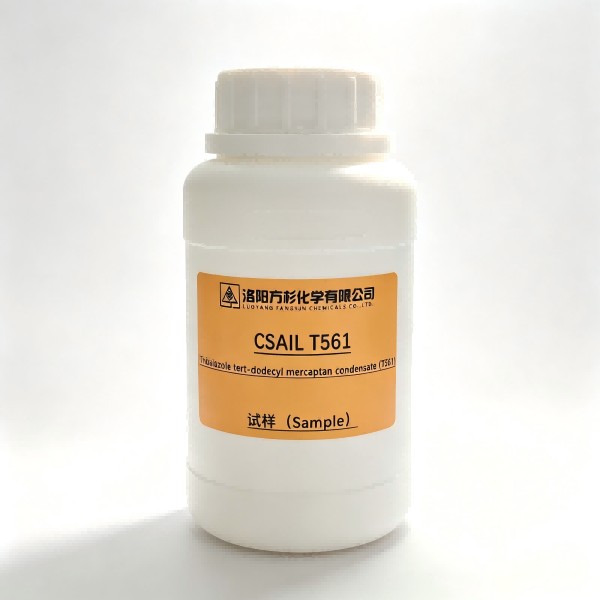
What CAS number and molecular data identify DMTD?
The parent compound is registered under CAS 1072-71-5. Its molecular formula is C2H2N2S3 and its molecular weight is about 150.2 g/mol. The same material appears in catalogues under several names, which is the first source of confusion.
| Identifier | Typical entry | Limit of this check |
|---|---|---|
| CAS number | 1072-71-5 | Applies to the parent compound only, not salts or derivatives |
| Formula | C2H2N2S3 | Does not tell you about moisture or by-products |
| Molecular weight | about 150.2 g/mol | Needed for molar dosing, but not a quality indicator |
| Alternative names | 1,3,4-thiadiazole-2,5-dithiol; bismuthiol | Names can be reused loosely, so always match the CAS number |
Two boundaries matter. First, alkali metal salts of the parent compound carry their own CAS numbers, so a matching name with a different CAS is a different product. Second, oil-soluble condensates made from this ring system have separate CAS numbers as well. For example, our CSAIL T561 condensate is registered under 59656-20-1, not 1072-71-5. Never accept one CAS number as a stand-in for the other in a purchase order.
Which grade details are most often confused?
This is the section most spec reviews skip, and it causes most disputes. Four items get mixed up: purity basis, water content, molecular data and solvent behaviour. The table separates them.
| Item | Common confusion | What to ask for | Boundary |
|---|---|---|---|
| Dry weight purity | Assay reported "as received" is read as dry-basis purity | Assay value plus the stated basis (as received or dry) | The two differ by roughly the water percentage, so small gaps are not always real quality gaps |
| Water content | Left off the CoA, or measured by an unstated method | Water percentage and method (Karl Fischer or loss on drying) | Loss on drying also counts other volatiles, so it can overstate water |
| Molecular data | Formula weight used to compare "activity" between a parent compound and a derivative | CAS number, formula and molecular weight for the exact product | Derivatives have different weights and sulfur content, so do not compare them per gram |
| Solvent dependent solubility | One solubility statement is assumed to hold in every medium | Solubility in your actual base oil, solvent or aqueous alkali, at your temperature | A solvent result does not predict oil behaviour |
Is dry weight purity the same as the assay on the CoA?
Not automatically. If a CoA lists an assay without naming the basis, ask. Here is a worked illustration (not product data): an as-received assay of 97.0% with 2.0% water corresponds to a dry-basis purity of 97.0 ÷ 0.98 ≈ 98.98%. Same powder, two headline numbers. Comparing a dry-basis figure from one supplier against an as-received figure from another will make the second look worse by about two points.
Does a low water content guarantee better performance?
No. Low moisture helps with handling, weighing accuracy and storage stability, but it says nothing about organic impurities or residual by-products. Judge water together with the assay and appearance, not as a stand-alone pass mark.
How soluble is DMTD, and in what?
The parent compound is a polar, sulfur-rich solid. In practice it dissolves poorly in non-polar mineral and synthetic base oils. It tends to dissolve better in polar organic solvents and in alkaline aqueous solutions, where its thiol groups form salts. Exact figures depend on grade, temperature and particle size, so run a bench check in your own medium.
| Medium | Expected behaviour (qualitative) | Practical note |
|---|---|---|
| Mineral oil / PAO | Very limited solubility | Direct blending of the powder is rarely practical |
| Water, neutral | Slight | Not suited to concentrate preparation |
| Alkaline water | Improved, through salt formation | Check pH stability and compatibility with the rest of the fluid |
| Polar organic solvents | Better than in oils | Solvent carry-over can affect flash point and seal compatibility |
Limits of this table: it is directional only. It does not replace a solubility test at your blending temperature, and it should not be used to promise a clear solution in a finished lubricant.
If the parent compound will not dissolve in my oil, what are the options?
Formulators usually move to oil-soluble thiadiazole derivatives. These keep the heterocyclic ring system but add alkyl groups to improve solubility in oil. Our range of dmtd additives for lubricant systems covers this route. The trade-off is that a derivative has its own sulfur content, activity and copper-passivation behaviour, so it needs fresh testing and cannot be swapped in at equal dose.
How do you write a purity specification into an RFQ?
Follow these steps and most ambiguity disappears before the first sample ships.
- State the CAS number and name. Write 1072-71-5 for the parent compound, or the derivative's own CAS number.
- Define the purity basis. Say "assay, dry basis" or "assay, as received" and name the method.
- Set a water limit with its method. Karl Fischer is cleaner than loss on drying for moisture alone.
- Specify appearance and form. Powder, granule or solution, since this affects dissolution time.
- Name your solvent or base oil. Ask the supplier to confirm solubility at your blending temperature, or run your own test.
- Request a CoA per lot and keep a retained sample for comparison.
What mistakes cause DMTD spec disputes?
- Comparing quotes on different bases. A dry-basis assay against an as-received assay.
- Trusting the name alone. Salt, parent compound and condensate may share part of a name.
- Skipping a solubility check. Solvent data does not transfer to base oil.
- Dosing by weight across different chemistries. A derivative with a higher molecular weight carries less ring per gram.
- Judging performance by purity alone. Performance must be confirmed by bench tests such as copper strip corrosion, oxidation stability and, for wear systems, four-ball or SRV friction testing.
When is the parent compound the wrong choice?
Choose the parent compound when you need the raw building block for synthesis or an aqueous alkaline system, and you can control moisture and dissolution. Choose a derivative when the target is an oil-based lubricant or grease where solubility drives stability. Neither choice fits if your problem is high friction coefficient, poor extreme-pressure results or oversized wear scars: those are usually solved by the EP/AW chemistry in the package, not by adjusting a corrosion inhibitor. In that case, look at the lubricant additive packages that bundle several functions and are tested together.
What can our team support during specification review?
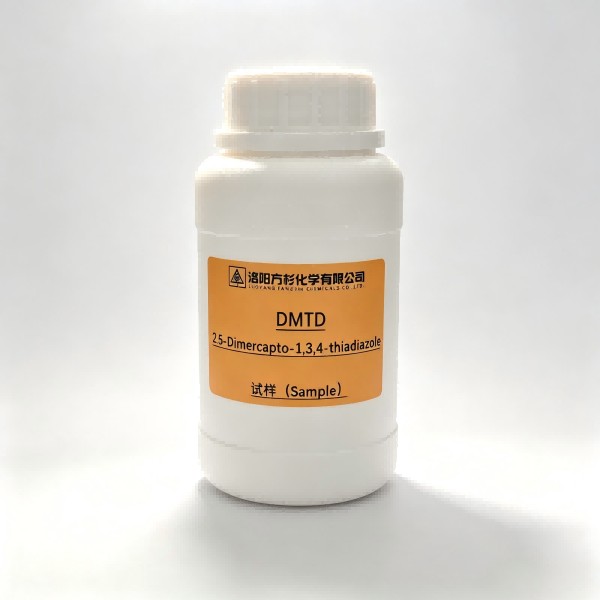
As a professional lubricant additive manufacturer founded in 2017, we run an R&D team of more than 30 PhD and master's degree holders, and our functional chemical capacity exceeds 10,000 tons. Our facility operates under ISO 9001:2015, ISO 14001:2015 and ISO 45001:2018 management systems. For evaluation work, samples ship within 3 days and bulk orders within 7 days, with no MOQ. If a delivered product does not meet the agreed quality, we negotiate a return with you.
Those terms apply to our own product range, which is centred on additive components and import-substitute packages. They do not mean every grade named in this article is stocked as a catalogue item, so confirm the exact material and spec with us first.
Send your target CAS number, purity basis, water limit and base oil to Daniel Zhang's team. We will tell you whether a thiadiazole derivative fits your formulation and can send a sample for your bench tests.
 WhatsApp
 Email
 +8616638861155