Why 2,5-Dimercapto-1,3,4-thiadiazole (DMTD) Stops Copper Corrosion in Lubricants and Metalworking Fluids
If your lubricant or coolant keeps failing copper strip corrosion tests, or if bronze bushings and brass fittings turn dark after a few weeks in service, the question isn't "do we need a corrosion inhibitor" — it's which chemistry actually binds to the metal surface instead of just floating in the formula. This is where 2,5-Dimercapto-1,3,4-thiadiazole (DMTD) gets asked about repeatedly by formulators dealing with yellow-metal attack. DMTD is a sulfur-and-nitrogen heterocyclic compound with two thiol groups that chemically adsorb onto copper, bronze, and brass surfaces, forming a passive film that blocks oxidation and sulfur attack. Below, we break down how it works, how to dose it correctly, and where it fails — with the practical details formulators actually need.
How DMTD Chemistry Protects Copper and Yellow Metals
DMTD's two mercapto (-SH) groups are the working part of the molecule. Each sulfur atom has a strong affinity for copper ions, so the molecule chemisorbs onto the metal surface rather than simply sitting in the oil phase. The result is a thin, tenacious film — often just a few molecular layers thick — that physically separates the metal from dissolved oxygen, moisture, and reactive sulfur species in EP additives.
This matters because many extreme-pressure lubricants contain sulfurized olefins or polysulfides that are aggressive toward copper by design — they're meant to react with ferrous metal surfaces under load. Without a deactivator, that same sulfur chemistry corrodes bronze gears, brass valves, and copper-based bearing cages. DMTD interrupts this by forming a Cu-DMTD complex that is far more stable than the copper-sulfide corrosion products that would otherwise form.
Formulators using sulfur-based EP/AW additives in gear oils almost always need a copper deactivator in the package — DMTD is one of the most cost-effective options because a small treat rate (often 0.05%–0.3% depending on the base system) delivers a measurable improvement in ASTM D130 copper strip ratings.
How to Use DMTD in Lubricants: A Step-by-Step Approach
Getting DMTD to perform consistently isn't just about adding it to the formula. Here's the sequence we recommend when qualifying it in a new lubricant or metalworking fluid:
- Confirm the corrosion mechanism first. Run a baseline copper strip test (ASTM D130) and an SRV or four-ball test on the formula without DMTD. If failures are driven by sulfur-EP attack rather than moisture, DMTD is the right tool; if the issue is purely aqueous rust on ferrous parts, a different inhibitor class is needed.
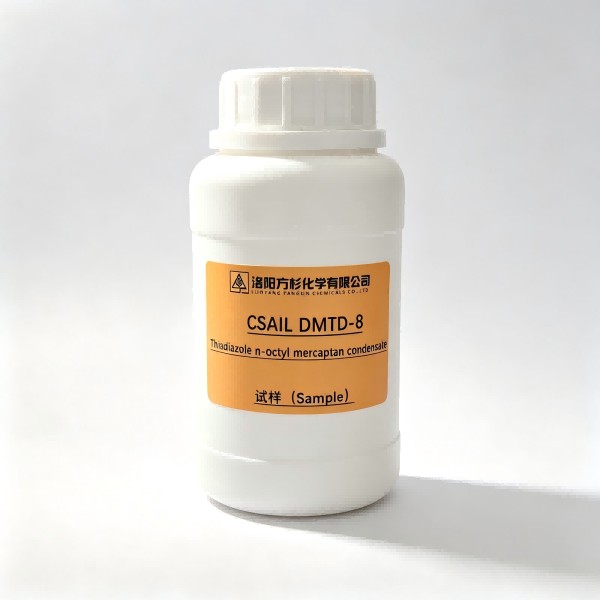
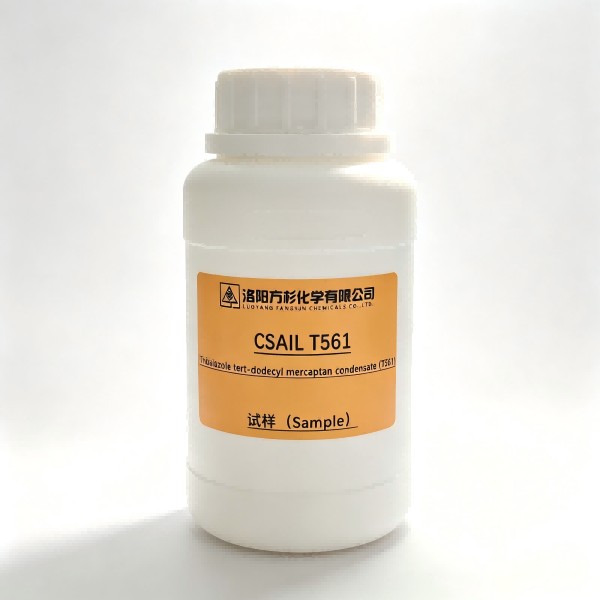
- Select the grade based on the carrier system. Oil-soluble condensates (such as thiadiazole tert-dodecyl mercaptan condensate) work well in mineral and synthetic base oils. Water-dispersible derivatives suit aqueous metalworking fluids and semi-synthetic coolants.
- Dose incrementally, not all at once. Start at 0.05% and step up in 0.05% increments while retesting copper strip rating and filterability at each level. Overdosing wastes cost and can push PB/PD values in the wrong direction if the EP package is sensitive.
- Check compatibility with existing additives. Some amine-based rust inhibitors and certain molybdenum friction modifiers can compete for the metal surface. Bench-test the full package, not DMTD alone.
- Validate under realistic load and temperature. Run SRV testing to confirm the copper film doesn't break down under boundary lubrication conditions — a common failure point when treat rate is too low for high-pressure gear applications.
- Re-test after thermal aging. DMTD can lose effectiveness if the formula undergoes extended high-temperature storage before use; an aged-sample copper strip check catches this before it reaches the customer.
Each step has a clear failure point. Skipping the incremental dosing step is the most common reason formulators either overspend on additive cost or still see copper staining in the field.
How Water Exposure, Metal Type, and Additive Compatibility Change DMTD Performance
DMTD doesn't behave the same way across every formulation. Three variables shift its performance more than anything else: water content, the specific metal being protected, and what else is in the additive package. The table below summarizes what we see across typical use cases.
| Condition | Effect on DMTD Performance | Formulator Action |
|---|---|---|
| Low water content (oil-based gear/hydraulic oil) | Oil-soluble DMTD derivatives form a stable film; good long-term protection | Use oil-soluble grade; treat rate 0.05%–0.2% |
| High water exposure (water-based metalworking fluids) | Standard oil-soluble DMTD may separate or lose dispersion, reducing film coverage | Switch to a water-dispersible thiadiazole derivative designed for aqueous systems |
| Copper and copper alloys (bronze, brass) | Strong chemisorption; DMTD is highly effective, often the primary line of defense | DMTD as main corrosion inhibitor, dose per ASTM D130 target |
| Ferrous metals (steel, cast iron) | DMTD offers limited direct protection; not a substitute for rust inhibitors | Pair with a dedicated ferrous rust inhibitor package |
| High sulfur EP additive loading | Increases corrosion risk, requiring higher DMTD treat rate to compensate | Re-test copper strip rating whenever EP additive concentration changes |
| Presence of strong amine rust inhibitors | Can compete for metal adsorption sites, sometimes reducing DMTD film stability | Bench-test full package before scale-up; adjust ratio if needed |
The practical takeaway: DMTD is a copper corrosion control additive first, and a general rust inhibitor second (or not at all). If your fluid runs in a system with both ferrous and non-ferrous parts — a common situation in gear oils with bronze synchronizers — you need DMTD working alongside, not instead of, a ferrous-metal inhibitor such as those in our black metal rust inhibitor range.
Common Mistakes When Formulating with DMTD Corrosion Inhibitor
- Treating DMTD as a universal rust inhibitor. It's a metal deactivator for copper and yellow metals — it does little for ferrous rust protection on its own.
- Skipping compatibility testing with EP/AW packages. Some phosphorus-based additives interact with DMTD's sulfur groups, reducing both EP performance and corrosion protection.
- Using an oil-soluble grade in a water-based coolant. Poor dispersion leads to uneven film formation and inconsistent copper strip results batch to batch.
- Underdosing to cut cost. A treat rate below the threshold needed for full surface coverage gives partial protection that looks fine in short tests but fails after extended field exposure.
- Not retesting after supplier or batch changes. Impurity profiles vary between DMTD condensate types (e.g., tert-dodecyl vs. tert-nonyl mercaptan condensates); a formula qualified with one grade shouldn't be assumed stable with another without retesting.
Choosing the Right DMTD Grade: A Buyer's Checklist
Before placing an order, formulators should confirm the following:
- Is the carrier system oil-based or water-based? This determines whether you need an oil-soluble condensate or a water-dispersible thiadiazole derivative.
- What's the target copper strip rating (ASTM D130) and current baseline without inhibitor?
- Does the formula already contain sulfur-based EP additives that increase copper corrosion risk?
- Are there amine-based or molybdenum additives in the package that need compatibility screening?
- What's the required treat rate range for your base oil viscosity and application (hydraulic, gear, grease, or metalworking fluid)?
- Can the supplier provide sample volumes quickly enough for bench trials before committing to bulk purchase?
On that last point: Luoyang Fangshan Chemical ships samples within 3 days and bulk orders within 7 days, with no minimum order quantity — useful when you're running multiple DMTD grade comparisons before locking in a formula. Our production facility is ISO 9001:2015 certified for quality management, with ISO 45001:2018 and ISO 14001:2015 certifications covering occupational safety and environmental management, and our R&D team of more than 30 PhD and master's degree holders supports formulation troubleshooting for import-substitute additive projects.
Worked Example: Bronze Worm Gear Oil Failing Copper Strip Tests
A common scenario: an industrial gear oil formula using a sulfurized olefin EP package passes four-ball EP testing but fails ASTM D130 copper strip at 100°C/3hr with a 3b or 4a rating — unacceptable for equipment with bronze worm gears. The fix sequence:
- Confirm the EP package is the corrosion driver (remove it temporarily and retest — if copper strip improves significantly, sulfur chemistry is confirmed as the cause).
- Add an oil-soluble DMTD condensate at 0.1% treat rate.
- Retest copper strip — target 1a or 1b rating.
- Confirm EP performance (four-ball weld load, PB/PD) hasn't shifted outside spec after the addition.
- Run SRV testing to confirm no increase in friction coefficient or wear scar diameter from the added inhibitor.
This sequence typically resolves copper strip failures without needing to reformulate the entire EP package — DMTD's role is narrow but effective when applied correctly.
DMTD Uses Across Lubricant and Fluid Categories
Beyond gear oils, 2,5-Dimercapto-1,3,4-thiadiazole uses extend across several product categories where yellow-metal components are present:
- Hydraulic fluids with bronze pump components — see our hydraulic oil additive packages for pre-balanced formulations.
- Industrial gear oils with bronze synchronizers or worm gears.
- Water-based metalworking fluids where copper or brass fixtures contact the coolant directly — our water-based additive series includes dispersible thiadiazole derivatives for this purpose.
- Greases for equipment with bronze bushings, where film persistence matters more due to lower additive replenishment.
- Metal cutting and grinding fluids, where fresh metal surfaces are especially reactive to dissolved oxygen and EP sulfur.
For formulators building a full package rather than sourcing single components, our additive package solutions already incorporate copper deactivation alongside EP/AW and rust protection chemistry, which can shorten the qualification cycle compared to balancing individual components from scratch.
Where DMTD Does Not Apply
DMTD isn't the right choice when the corrosion issue is purely ferrous rust, when the system requires food-grade or ashless certification that conflicts with sulfur-heterocyclic chemistry limits, or when extremely high-temperature oxidative stability is the primary failure mode rather than copper attack — in that case, antioxidant chemistry needs separate attention, not more corrosion inhibitor. If your formula problem sits outside copper and yellow-metal protection, a thiadiazole or thiazole-based deactivator from our broader thiadiazole-based corrosion inhibitor range may need to be paired with a different additive class entirely.
If you're troubleshooting copper strip failures, SRV wear results, or PB/PD shortfalls tied to EP additive corrosivity, send us your current formula parameters — our technical sales team can recommend a DMTD grade and treat rate, and arrange a sample for bench trial.
 WhatsApp
 Email
 +8616638861155