How DMTD Tautomerism Shapes Solubility, Reactivity, and Additive Compatibility
Why does a corrosion inhibitor that tests perfectly in one base oil fail to dissolve in another, or suddenly lose its plating resistance once pH shifts? For formulators working with 2,5-Dimercapto-1,3,4-thiadiazole (DMTD), the answer usually traces back to one structural quirk: tautomerism. This single molecule can exist in two interconvertible forms, and which form dominates in your system directly affects solubility, metal-surface bonding, and how well it plays with other additives in the package.
This article breaks down the chemistry in plain terms, answers the boundary questions R&D teams ask before switching suppliers, and gives you a practical checklist for sourcing DMTD-based intermediates without formulation surprises.
2,5-Dimercapto-1,3,4-thiadiazole Structure and Why It Shifts Form
The 2,5-Dimercapto-1,3,4-thiadiazole structure contains a five-membered ring with two sulfur-bearing carbon positions, each capable of existing as a free thiol (-SH) group or as a thione (C=S) tautomer paired with an adjacent N-H. These two forms are not separate compounds — they're the same molecule, constantly shifting between arrangements depending on solvent polarity, pH, and temperature.
In nonpolar or mildly polar lubricant base oils, the thione form tends to dominate because it's thermodynamically more stable in low-dielectric environments. In polar systems — water-based metalworking fluids, amine-rich packages, or alcohol-based carriers — the thiol form becomes more accessible, exposing the sulfur's lone pair for metal coordination and reaction with other functional additives.
This is the core reason DMTD derivatives (like the tert-dodecyl mercaptan condensate used in many finished inhibitor packages) perform differently across oil-based versus water-based chemistries, even when concentration is identical.
Why Does DMTD Change Form? Boundary Questions Formulators Ask
This section answers the practical questions technical buyers raise before committing a formulation to DMTD or its derivatives — including where the tautomer effect helps, and where it creates limits.
Does tautomer ratio change solubility in finished oils?
Yes, measurably. The thione-dominant state has lower affinity for polar co-solvents, which is why raw DMTD shows limited solubility in pure mineral oil without a carrier or derivatization step. Converting it to a thioether derivative (such as the tert-nonyl or tert-dodecyl mercaptan condensates) locks part of the reactive sulfur into a more oil-compatible backbone, improving dispersion without eliminating the corrosion-inhibiting sulfur sites.
Does the tautomer shift affect reactivity with metal surfaces?
Yes, and this is the main reason DMTD is valued as a corrosion inhibitor and metal deactivator. The thiol form bonds more readily to copper, silver, and yellow-metal surfaces through sulfur-metal coordination, forming a passivation layer. If your formulation keeps DMTD locked in thione-dominant conditions (very nonpolar, low-moisture systems), surface bonding can be slower to establish — not absent, but slower, which matters in short-cycle metalworking applications where protection needs to form within minutes of contact.
Can tautomerism cause batch-to-batch inconsistency?
Not if the derivative is properly characterized. Raw DMTD itself can show apparent variability in solubility tests because small shifts in pH or trace moisture push the tautomer equilibrium one way or another. This is a genuine limitation of using underivatized DMTD directly in finished lubricants. It's one reason most commercial formulations use DMTD condensates or thiadiazole derivatives rather than the parent molecule — the condensation reaction stabilizes the reactive sulfur in a defined chemical environment, reducing lot-to-lot solubility drift.
Where does this NOT matter?
If your package already uses a pre-reacted thiadiazole derivative (rather than raw DMTD powder), tautomerism is largely a background consideration — the derivatization step has already fixed much of the reactive behavior. The boundary question only becomes urgent when a formulator is working with raw DMTD as a starting material for in-house synthesis, or when switching between two suppliers' derivatives that use different condensation chemistries.
Thiol Form vs Thione Form: A Side-by-Side Comparison
The table below summarizes practical formulation differences between the two tautomer states, useful when troubleshooting solubility or performance gaps.
| Property | Thiol-dominant form | Thione-dominant form |
|---|---|---|
| Favored environment | Polar / aqueous systems, higher pH | Nonpolar oils, low moisture |
| Metal-surface bonding speed | Faster, stronger initial chemisorption | Slower, more gradual surface coverage |
| Oxidative stability | More reactive, can oxidize to disulfide over time | Comparatively more stable at rest |
| Typical application fit | Water-based metalworking fluids, cleaning formulations | Mineral and synthetic oil-based packages |
| Compatibility risk | Can react prematurely with free amines or strong oxidizers | Lower reactivity, but weaker short-term metal passivation |
DMTD Solubility: What Determines It in Practice
DMTD solubility is governed less by the tautomer ratio alone and more by how the molecule is delivered into the formulation. Three practical factors decide whether a DMTD-based additive disperses cleanly or causes haze and sediment:
- Derivative chemistry: Mercaptan-condensed DMTD derivatives (tert-nonyl, tert-dodecyl) carry longer alkyl chains that improve oil compatibility far beyond what raw DMTD achieves alone.
- Carrier solvent selection: Even compatible derivatives can show marginal solubility if the base oil has very low aromatic content; a small co-solvent addition often resolves this.
- Temperature during blending: Thiadiazole derivatives dissolve more completely when blended at 50-60°C rather than cold-mixed, since the tautomer equilibrium shifts and viscosity drops together.
For R&D teams validating a new source, we recommend requesting a small working sample and running it through your actual blend temperature profile, not just a bench solubility spot test at room temperature.
Thiadiazole Additive Compatibility Across Common Formulations
Compatibility problems involving DMTD-based inhibitors rarely come from the thiadiazole ring itself — they come from side reactions with other package components. Below is a practical compatibility checklist formulators use before finalizing a blend:
- Check free amine content in the package — primary amines can form salts with the thiol form, reducing active inhibitor availability over storage time.
- Avoid pairing with strong oxidizing EP additives unless oxidative stability has been tested together; the thiol form is more reactive to oxidation.
- Confirm compatibility with yellow-metal passivators already in the formula — DMTD derivatives can overlap in function with benzotriazole or tolyltriazole types, sometimes competing for the same metal sites rather than adding protection.
- Test pH stability if working in a water-based metalworking fluid; tautomer shifts near pH 9-10 can change how the inhibitor partitions between the aqueous and oil phases of an emulsion.
Formulators pairing DMTD derivatives with phosphorus-based EP agents, sulfurized olefins, or organic molybdenum friction modifiers generally see good synergy, since these chemistries operate on different wear-protection mechanisms and don't compete for the same active sites.
A Worked Example: Switching Base Oil Mid-Formulation
Consider a gear oil formulator moving from a Group I mineral base to a Group III synthetic base, keeping the same DMTD-derived corrosion inhibitor dosage. The synthetic base has lower polarity and less natural solvency. In testing, the inhibitor shows visible haze at 0.3% treat rate — a solubility issue traced directly to the tautomer's reduced thiol exposure in the less polar base.
The practical fix: increase the alkyl-chain-length derivative ratio (switching from a tert-nonyl to a tert-dodecyl condensate, which carries better oil solvency) or add a small percentage of a compatible phosphate ester as a co-solvent carrier. This resolves the haze without changing the active sulfur content delivering corrosion protection. This is a common scenario when customers request reformulation support alongside a thiadiazole-based metal corrosion inhibitor switch.
Common Mistakes When Sourcing or Formulating with DMTD Derivatives
- Treating all thiadiazole derivatives as interchangeable: A DMTD-9 condensate and a DMTD-12 condensate differ in alkyl chain length, which changes oil solubility and volatility — not a drop-in swap.
- Skipping blend-temperature validation: Cold-mixing can leave undissolved particulate that passes a quick visual check but causes filter clogging downstream.
- Ignoring amine content in the finished package: Salt formation with amines is a slow process; short-term compatibility tests can miss it.
- Assuming solubility data from one base oil transfers to another: Always re-verify when switching base oil group or viscosity grade.
Buyer's Checklist Before Selecting a DMTD-Based Additive Supplier
- Request the specific derivative structure (not just "DMTD") and its CAS number for traceability.
- Ask for solubility data in your actual base oil, not a generic reference oil.
- Confirm whether the supplier can support custom additive package formulation if your current blend needs rebalancing around the inhibitor.
- Check lead time for samples versus bulk — short sample turnaround lets your lab validate compatibility before committing to volume.
- Verify quality system certification behind the supplier's manufacturing process.
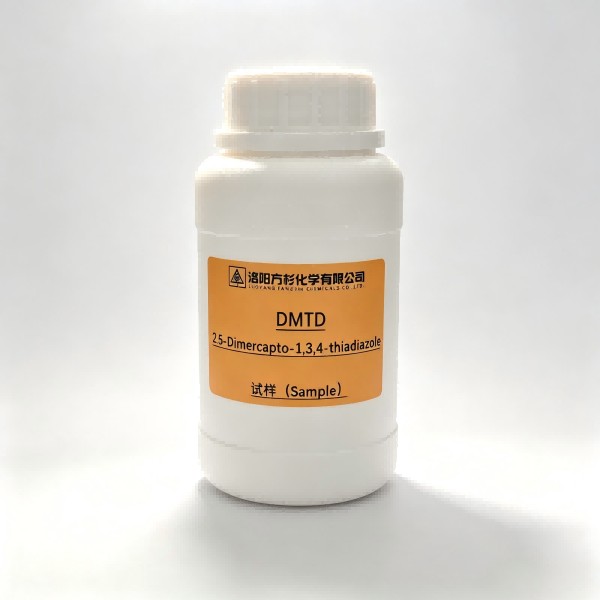
Luoyang Fangshan Chemical operates under ISO 9001:2015, ISO 45001:2018, and ISO 14001:2015 systems, with sample dispatch typically within 3 days and bulk orders within 7 days, and no minimum order quantity — useful when a lab needs to validate a derivative like DMTD-9 or DMTD-12 before scaling up. Our R&D group, made up of more than 30 PhD and master's degree holders, works directly with customer formulation teams on compatibility questions like the ones covered above.
Choosing Between Raw DMTD and Derivative Forms
If your application calls for maximum flexibility to tune the molecule in-house — custom esterification, salt formation, or proprietary condensation — raw DMTD is the right starting point, with the understanding that tautomer-driven solubility variability needs to be managed at your own blending stage.
If your priority is a predictable, ready-to-blend corrosion inhibitor with established oil or water compatibility, a pre-reacted derivative such as a tert-dodecyl or tert-nonyl mercaptan condensate is the more practical choice. These are available as part of our broader range of lubricant additive components, and can be formulated alongside EP/AW chemistry for full lubricant additive packages when needed.
For water-based metalworking fluids specifically, derivative selection matters even more because the aqueous phase pushes the molecule toward its thiol-dominant state — worth discussing with your supplier's technical team before finalizing a formula, particularly if you're also sourcing metalworking fluid additives from the same package.
Limits of This Guidance
Tautomerism explains solubility and reactivity trends, but it doesn't predict every formulation outcome on its own. Trace metal contamination, surfactant packages in water-based systems, and storage temperature all interact with the tautomer equilibrium in ways that bench chemistry alone can't fully anticipate. Lab validation in your actual formulation remains the final step — this article is a starting framework for diagnosing problems, not a replacement for compatibility testing.
If you're evaluating a DMTD derivative for a new or reformulated additive package, send us your base oil type and treat rate target — we can recommend a specific derivative and arrange a sample for your lab to validate.
 WhatsApp
 Email
 +8616638861155