2,5-Dimercapto-1,3,4-thiadiazole (DMTD) Stops Copper From Triggering Oxidation Inside Your Lubricant
Why does a gear oil built from a clean base stock and a well-tested oxidation package still turn dark and sour after 400-600 hours in service, long before the bench-test oxidation life would predict? In most cases the culprit is not the oil itself — it is copper. Bronze bushings, brass gear carriers, copper cooling coils and bearing cages all release trace copper ions into circulating oil, and those ions act as a catalyst that tears oxidation inhibitors apart far faster than heat alone would. This is exactly the problem 2,5-Dimercapto-1,3,4-thiadiazole (DMTD) was developed to solve. Formulators working on turbine oils, hydraulic fluids, gear oils and metalworking fluids add DMTD, or one of its derivatives, specifically to neutralize copper's catalytic effect before it starts a chain reaction of acid formation, varnish, and sludge.
This article explains the chemistry behind that protection, what happens when the dosage or grade is wrong, and how to specify DMTD correctly for your formulation.
Why Copper Is a Hidden Oxidation Accelerator
Copper and its alloys are everywhere in industrial equipment — bushings, thrust washers, radiator tubes, and electrical contacts inside hydraulic systems. Under normal conditions copper surfaces look stable. Under oil-wetted, heated conditions, however, copper ions migrate into the lubricant and behave as a two-electron catalyst, accelerating the breakdown of hydroperoxides that form naturally during oxidation. One copper ion can trigger thousands of oxidation chain reactions before it is consumed. The practical result:
- Acid number climbs faster than the oxidation stability test predicted
- Varnish and sludge appear even though antioxidant levels look correct on paper
- Copper parts themselves corrode and pit, generating more free copper ions — a self-feeding cycle
A phenolic or aminic antioxidant alone cannot stop this cycle because it addresses free radicals, not the metal catalyst feeding them. That is where a dedicated copper deactivator becomes necessary, and why DMTD lubricant additive chemistry is standard in turbine oil, gear oil, and compressor oil formulations.
The Surface-Film Mechanism: How DMTD Actually Passivates Copper
This is the part formulators most often ask about: how does DMTD prevent copper corrosion at the molecular level, rather than just "deactivating" it in a general sense?
DMTD has two thiol (-SH) groups attached to a thiadiazole ring. Those sulfur atoms have a strong affinity for copper. When DMTD molecules contact a copper surface, the thiol groups donate electron density to the copper atoms and form a chemisorbed, insoluble copper-mercaptide layer directly on the metal surface. This is not a loose physical coating — it is a chemical bond strong enough to resist being washed away by circulating oil.
That thin film does three things simultaneously:
- Blocks ion release. The passivation layer physically separates bulk oil from the copper substrate, so far fewer copper ions dissolve into the lubricant in the first place.
- Deactivates catalytic sites. Any copper ions already in solution get complexed by DMTD's sulfur donor atoms, tying up the coordination sites copper needs to catalyze peroxide decomposition.
- Protects the thiadiazole ring itself under heat. Because the ring structure is thermally stable, the film holds up under sustained operating temperatures rather than breaking down and re-exposing bare copper.
In practical terms, this is why oils formulated with a thiadiazole metal passivation additive consistently outperform oils relying on antioxidants alone in copper-corrosion bench tests and in field service where bronze or brass components are present. You can review the underlying chemistry family on our thiadiazole-based metal corrosion inhibitors page, which covers several DMTD derivative structures used across different base oil chemistries.
Key Performance Parameters — What Happens If You Get Them Wrong
Choosing the right DMTD copper deactivator grade and treat rate is not just a matter of picking a number off a datasheet. Each parameter below affects a specific failure mode, and getting it wrong produces a specific, predictable problem.
| Parameter | What It Actually Controls | Consequence of Getting It Wrong |
|---|---|---|
| Copper strip corrosion rating | Whether copper surfaces stay bright or tarnish under heat soak | Under-dosing leaves copper exposed; strip rating drifts from 1a toward 3-4, signaling active corrosion and future oxidation acceleration |
| PB / PD load values | Film strength under boundary lubrication before metal-to-metal welding occurs | If DMTD derivative is used as a stand-alone EP agent rather than combined with proper EP/AW chemistry, PB and PD will not meet gear or hydraulic specs — DMTD is a passivator, not a primary EP additive |
| Wear scar diameter (4-ball test) | Anti-wear film thickness and durability under sliding contact | Relying on DMTD alone produces oversized wear scars; it must be paired with AW agents such as phosphate esters or sulfur-based additives |
| SRV friction coefficient | Energy loss and heat generation under oscillating contact | A copper-deactivator-only package will not lower friction coefficient; formulators sometimes misdiagnose high SRV friction as a DMTD dosage issue when the real gap is in the friction modifier package |
| Oxidation induction time (RPVOT / PDSC) | How long the oil resists the start of rapid oxidation | Under-treating DMTD in copper-rich systems shortens induction time sharply, even with a strong antioxidant package, because the copper catalyst is still active |
The practical takeaway: DMTD solves copper-catalyzed oxidation specifically. It does not fix high friction coefficients, poor EP performance, or large wear scars on its own — those require complementary chemistry from phosphorus or sulfur-based EP/AW additives. We see this confusion often when customers run an SRV test or wear scar test, get a disappointing result, and assume the copper deactivator failed, when in fact the issue sits in a different part of the additive package.
DMTD Derivatives Compared — Choosing the Right Structure
Not all DMTD-based products are interchangeable. The alkyl chain attached to the thiadiazole ring changes solubility, volatility, and compatibility with different base oils.
| Derivative Type | Typical Base Oil Fit | Notable Property |
|---|---|---|
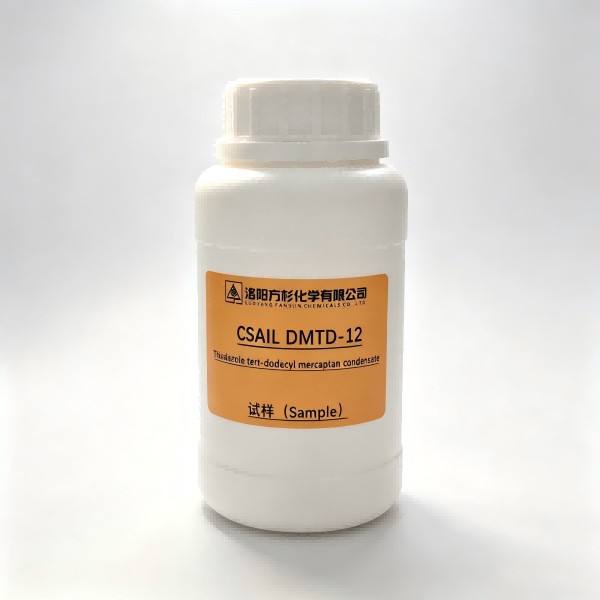
| DMTD tert-dodecyl mercaptan condensate | Mineral and semi-synthetic gear oils, hydraulic fluids | Good balance of copper passivation and oil solubility; widely used general-purpose grade |
| DMTD tert-nonyl mercaptan condensate | Metalworking fluids, water-based systems | Shorter chain improves dispersibility in aqueous and semi-synthetic formulations |
| Thiadiazole derivatives for water-based series | Water-soluble and semi-synthetic metalworking fluids | Formulated for compatibility with emulsifiers and water-dilutable systems |
Buyers formulating water-dilutable metalworking fluids should look specifically at grades built for that chemistry rather than standard oil-soluble DMTD condensates — solubility mismatches show up as haze, separation, or reduced copper protection in the diluted fluid. Our water-based metalworking additives line includes thiadiazole derivatives engineered for this purpose.
Common Mistakes When Specifying DMTD in a Formulation
- Treating it as a universal EP additive. DMTD protects against copper-catalyzed oxidation and copper corrosion — it is not designed to carry extreme-pressure load alone.
- Under-dosing in high-copper systems. Turbine oils and hydraulic systems with significant copper or bronze surface area need higher treat rates than a system with mostly steel and aluminum contact.
- Ignoring compatibility with other sulfur chemistry. Combining DMTD with heavily sulfurized EP additives without checking copper strip results can produce unexpected staining in some formulations.
- Skipping SRV or RPVOT verification after reformulation. A copper deactivator swap can shift oxidation induction time even when every other component stays the same — always re-test rather than assume equivalence.
- Assuming all thiadiazole grades perform identically. Chain length and purity affect both solubility and the strength of the copper-mercaptide film; a cheaper, lower-purity grade may pass copper strip testing initially but degrade faster in service.
A Formulator's Decision Checklist
Before finalizing a DMTD treat rate for a new or reformulated lubricant, work through this checklist:
- Identify every copper-alloy component the oil will contact — bushings, cooling coils, electrical contacts, bearing cages.
- Run a baseline copper strip test (ASTM D130 or equivalent) on the formulation without DMTD to establish the severity of the problem.
- Select a DMTD derivative matched to base oil type — oil-soluble condensate for mineral/synthetic oils, water-compatible grade for aqueous metalworking fluids.
- Set an initial treat rate and verify copper strip rating returns to 1a or better after heat aging.
- Re-check PB/PD, wear scar, and SRV friction results separately — confirm the EP/AW package still performs after the DMTD addition.
- Run RPVOT or PDSC to confirm oxidation induction time improvement versus the undosed baseline.
- Document the formulation and retain samples for field-performance comparison after 500-1000 hours of service.
Formulators who need help balancing a DMTD copper deactivator against a full additive package — AW agents, antioxidants, friction modifiers — can review ready-built options on our lubricant additive packages page, or combine single components through our additive components catalog.
Sourcing Considerations for Import-Substitute DMTD Supply
Luoyang Fangshan Chemical operates under ISO 9001:2015 quality management, ISO 45001:2018 occupational health and safety, and ISO 14001:2015 environmental management systems. The company was founded in 2017 and now runs production capacity exceeding 10,000 tons of functional chemicals annually, supported by an R&D team of more than 30 PhD and master's degree holders focused on import-substitute additive chemistry.
For buyers evaluating a new DMTD supplier, a few practical points matter beyond the technical datasheet:
- Samples are typically dispatched within 3 days, so lab verification does not stall a project for weeks.
- Bulk orders ship within 7 days once specifications are confirmed.
- There is no minimum order quantity, which helps when qualifying a new grade in small trial batches before committing to full-scale purchasing.
- If a delivered batch shows a genuine quality issue against agreed specification, returns can be negotiated directly rather than through a rigid claims process.
Putting DMTD Into Practice: A Worked Scenario
Consider a turbine oil formulator seeing RPVOT values drop from 500 minutes to 280 minutes after six months of service, with no change in antioxidant loading. Copper strip tests on return samples show 3b ratings — clear evidence of active copper corrosion. The fix is not more antioxidant; it is adding or increasing a DMTD lubricant additive treat rate to break the copper-ion feedback loop. After introducing a DMTD tert-dodecyl mercaptan condensate at an appropriate treat level, copper strip ratings typically return toward 1a, and RPVOT life recovers because the catalytic pathway has been shut down rather than just slowed.
This scenario illustrates the core point of this article: DMTD does not boost oxidation resistance by strengthening the antioxidant chemistry itself. It protects the antioxidant package by removing the metal catalyst that was destroying it. For related anti-wear and friction-modifier chemistry that often needs to be paired with DMTD in a full formulation, see our organic molybdenum friction modifiers options.
Request Technical Support or a Sample
If you are formulating or reformulating a turbine oil, hydraulic fluid, or metalworking fluid with copper-alloy contact, send us your base oil type and operating temperature range, and our technical team can recommend a DMTD derivative and starting treat rate, along with a sample for bench verification.
 WhatsApp
 Email
 +8616638861155