How Do Dialkyl Dithiocarbamates Oxidize?
What happens when a sulfur-containing dithiocarbamate encounters air, peroxide, dissolved metal ions, or a deliberate laboratory oxidant? The short answer is that a Dialkyl dithiocarbamate can lose electrons and form a new sulfur-to-sulfur bond, producing a thiuram disulfide. That change may alter solubility, reactivity, analytical results, and the behavior of a lubricant-additive blend.
For formulators and laboratory teams, the useful question is not simply whether oxidation occurs. It is whether the material remains in its intended ionic or salt form, whether oxidation has already generated disulfide content, and whether that conversion affects the formulation function being evaluated. The answer depends on chemical form, oxidant type, water exposure, metal contamination, temperature history, and test conditions.
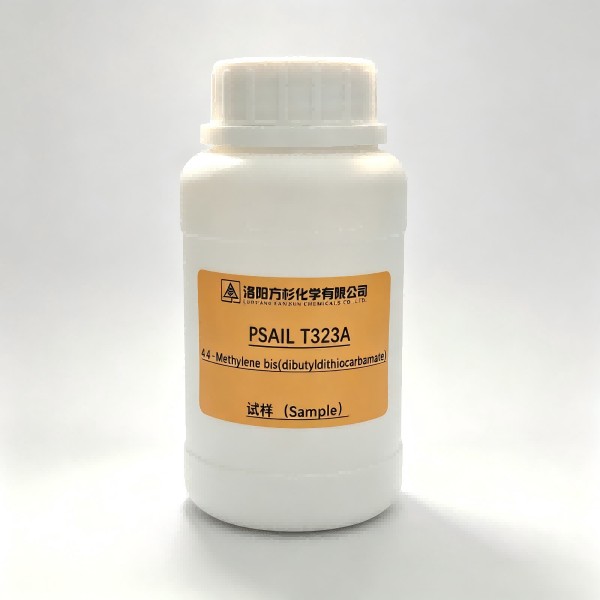
The direct reaction and why it matters in additive work
Dithiocarbamates are sulfur-rich compounds often represented in their anionic form as R2NCS2−, where R represents alkyl substituents. The negative charge is delocalized across the nitrogen-carbon-sulfur system. In practice, the anion may be paired with a counterion, incorporated into a metal complex, or present as part of a formulated additive system.
Under oxidation, two dithiocarbamate units can couple through sulfur atoms to form a thiuram disulfide:
2 R2NCS2− → (R2NC(S)S)2 + 2 e−
The reaction is simple on paper. Its consequences are not always simple in a working fluid. The starting species is an anionic sulfur donor, while the product is a neutral disulfide containing an S–S linkage. That shift can change how the material partitions between oil and water, how it coordinates with metals, and how it responds in chromatographic or spectroscopic analysis.
A practical conclusion follows: if a laboratory is evaluating a dithiocarbamate as an active additive component, it should not assume that a result measured after oxidative exposure represents the original chemical species. This applies especially when samples have encountered residual oxidizer, reactive cleaning agents, metal-containing equipment, or an intentionally harsh oxidation test.
This does not mean every darkened sample or every viscosity change proves thiuram disulfide formation. Color, haze, sediment, odor, and performance drift can have several causes. Confirmation requires an appropriate analytical comparison against a retained reference sample and a defined test method.
Mechanism of conversion into thiuram disulfides
The central oxidation mechanism is electron removal from the sulfur-containing dithiocarbamate species, followed by coupling of two sulfur-centered reaction partners. The resulting thiuram disulfide has a sulfur-sulfur bridge connecting two thiocarbamoyl groups. The key transformation is therefore not merely “loss of sulfur” or “decomposition.” It is a structural reorganization that creates a new covalent S–S bond.
| Reaction feature | Starting dithiocarbamate form | Thiuram disulfide product | Practical implication |
|---|---|---|---|
| Overall charge | Usually anionic before pairing with a counterion | Generally neutral | Solubility and phase behavior may differ from the original salt or ionic species. |
| Reactive sulfur arrangement | Two sulfur atoms associated with one thiocarbamoyl group | Two units joined by an S–S bond | The sulfur donor environment available for later reactions has changed. |
| Redox state | Reduced relative to the coupled disulfide | Oxidized coupling product | Oxidation history must be considered when interpreting stability or activity tests. |
| Molecular size | One dithiocarbamate unit | Two units linked together | Analytical methods may show a different molecular signal or retention pattern. |
| Metal interaction | May act as a ligand or sulfur donor depending on formulation chemistry | Has a different sulfur arrangement and coordination behavior | Do not treat metal-binding behavior of the starting material and oxidation product as equivalent. |
Which oxidants can drive the reaction?
Several oxidants are known to convert dithiocarbamates into thiuram disulfides. Common laboratory examples include iodine, bromine, ferricyanide, iron(III) species, and hydrogen peroxide. These reagents differ in redox potential, phase compatibility, reaction speed, and side-reaction risk. They should therefore not be treated as interchangeable test tools.
- Iodine and bromine: Useful examples of direct chemical oxidation. They can show the basic disulfide-forming route clearly, but they are not representative of every lubricant-storage environment.
- Ferricyanide: A water-phase oxidant that can be useful in controlled analytical or mechanistic work. Its relevance decreases if the commercial system is oil-based and has little water exposure.
- Iron(III): Relevant when considering redox-active metal contamination or deliberate oxidation chemistry. The actual response depends on ligand chemistry, moisture, acidity, and whether iron is present as a soluble species or surface-associated residue.
- Hydrogen peroxide: Relevant to cleaning residues, aqueous processing, and oxidation studies. Excess peroxide or inappropriate conditions may lead beyond the desired disulfide product, so a positive result does not automatically define normal storage behavior.
The conclusion is straightforward: oxidant identity determines more than reaction speed. It also determines whether thiuram disulfide is the main product or only one member of a wider reaction mixture. This distinction matters when a buyer requests a stability statement based on an unspecified “oxidation test.” The test oxidant, solvent system, concentration, duration, temperature, and sample preparation must be stated before results can be compared.
Conditions that change the apparent oxidation risk
Oxidation is governed by interacting conditions rather than a single material property. A compound that appears stable in a sealed, dry reference sample may react differently after contact with water, a strong oxidant, a metal surface, or an incompatible additive. The following factors should be assessed together.
| Condition to review | What it affects | When it matters most | Limit of interpretation |
|---|---|---|---|
| Oxidant identity and amount | Reaction route, rate, and possible side products | Peroxide cleaning, deliberate screening, oxidizing contamination | A strong laboratory oxidant does not predict routine storage life by itself. |
| Water content and phase contact | Ion mobility, hydrolysis-related chemistry, and access to water-soluble oxidants | Water-based fluids, tank contamination, humid handling | Water presence alone does not prove oxidation has occurred. |
| Metal ions and metal surfaces | Redox pathways and coordination chemistry | Contaminated vessels, mixed-metal systems, corrosion studies | Surface metal and dissolved metal ion effects can differ substantially. |
| Temperature history | Reaction rate and compatibility changes | Warm storage, processing, accelerated studies | Higher temperature can speed reactions but does not identify the reaction product. |
| Base oil and co-additives | Solubility, diffusion, competing reactions, and analytical visibility | Finished industrial oils and additive packages | Results from a neat chemical may not transfer directly to a blended oil. |
For oil formulation work, evaluate the dithiocarbamate in the actual base oil and additive environment whenever possible. A neat-material test is useful for understanding intrinsic reactivity, but it does not capture dilution, solvency, antagonism, or reaction with companion additives.
For example, a formulator comparing a sulfur-based antiwear component with phosphorus-based chemistry should evaluate the complete package rather than assign a final performance conclusion to a single additive. Related options can be reviewed among high-quality lubricant additive components & chemical additives, but compatibility and finished-oil validation still belong to the formulation program.
What material changes can be observed and what they do not prove
The formation of thiuram disulfide may cause observable changes, but visual inspection is only a screening step. A change in appearance can trigger investigation; it cannot identify the structure on its own.
- Haze or sediment: This can indicate reduced solubility, contamination, or formation of higher-molecular-weight material. It fits a situation where the blend has been stored or exposed to moisture. It does not prove an S–S coupled product without analysis.
- Color change: This may arise from oxidation, metal interaction, or other degradation pathways. It is useful as a comparison against a retained control, not as a standalone acceptance criterion.
- Different chromatographic profile: A new peak with a different retention time may indicate conversion to a larger, less polar, or differently interacting species. Identification still requires a reference standard, mass information, or another confirming technique.
- Changed sulfur response: Sulfur-selective or elemental methods can confirm that sulfur-containing material is present, but they do not necessarily distinguish the original compound from a disulfide product.
One common mistake is to equate total sulfur with retained active chemistry. Total sulfur may remain broadly similar even though the arrangement of sulfur atoms has changed. The molecule can therefore lose its intended chemical role without a proportionate loss in elemental sulfur.
Common interpretation mistakes
- Mistake: “No precipitate means no oxidation.” Correction: A soluble thiuram disulfide or low-level conversion may not create visible solids.
- Mistake: “Peroxide exposure always yields only thiuram disulfide.” Correction: Peroxide conditions can produce further reactions, especially when exposure is excessive or other reactive species are present.
- Mistake: “An accelerated test predicts field storage exactly.” Correction: Accelerated studies rank or stress materials under selected conditions; they do not reproduce every storage and use environment.
- Mistake: “A metal-containing sample behaves like the free anion.” Correction: Metal coordination changes electron distribution and reaction pathways, so results must be interpreted by chemical form.
- Mistake: “One additive can be judged apart from the package.” Correction: In formulated lubricants, base oil, inhibitor selection, antiwear chemistry, and contaminants all influence the observed result.
A practical verification sequence for laboratory and sourcing teams
When oxidation is suspected, use a controlled comparison rather than a single end-point test. The sequence below is suitable for early-stage investigation. It does not replace a customer-specific qualification plan or product specification.
- Define the chemical form. Record whether the sample is a salt, metal complex, concentrate, or finished blend. This determines what comparison standard is meaningful.
- Secure a retained reference. Keep an unopened or properly stored reference sample from the same material for side-by-side visual and analytical comparison.
- Record exposure history. Identify contact with peroxide cleaners, oxidizing agents, water, metal debris, elevated heat, and incompatible additives. Do not omit container and transfer-line history.
- Inspect physical condition. Compare color, clarity, odor, sediment, and phase separation. Treat these as investigation triggers, not final identification.
- Run a chemical comparison. Select a suitable method such as chromatography, spectroscopy, or mass-based identification to compare the suspected sample with the reference and, where available, a thiuram disulfide standard.
- Test the actual formulation. If the material will be used in oil, evaluate the relevant blend rather than only the neat component. Check whether the observed conversion changes blend clarity, corrosion behavior, oxidation response, or tribological results under the selected protocol.
- Document the test conditions. Report solvent, oxidant, temperature, time, water presence, metal exposure, and method settings. Without those details, another laboratory cannot interpret the result reliably.
For blends requiring coordinated antiwear and corrosion-control chemistry, it can be useful to review compatible families such as thiadiazole-based metal corrosion inhibitors and phosphate amine salt ep/aw additives & anti-wear agents. These are starting points for formulation discussions, not evidence that any specific combination is suitable without validation.
How technical buyers should specify oxidation-related requirements
A buyer should avoid asking only for “good oxidation stability.” That phrase is too broad to establish a testable purchasing requirement. Instead, state what chemical form is being purchased, which exposure condition is relevant, and what evidence will be reviewed.
| Buyer question | Why it changes the decision | Evidence to request |
|---|---|---|
| Is the supplied material a salt, complex, concentrate, or finished package? | Each form may have different solubility and oxidation behavior. | Product identity, technical data, and intended-use description. |
| Which oxidation exposure is relevant to our process? | Peroxide contact, air exposure, metal contamination, and heat do not create identical test conditions. | Written test plan with named oxidant or storage condition. |
| What chemical change are we trying to detect? | Appearance, total sulfur, and compound identity answer different questions. | Method description and acceptance criterion tied to the intended risk. |
| Will the material be tested neat or in formulated oil? | Finished-oil results are more relevant when additive interactions are expected. | Base oil, dosage, blend order, and conditioning details. |
| What sample and supply flexibility are needed for qualification? | Early screening may require small quantities before larger blending trials. | Sample plan, documentation list, and delivery schedule. |
At Luoyang Fangshan Chemical Co., Ltd., we can support early evaluation with samples dispatched within 3 days and larger shipments dispatched within 7 days, with no minimum order quantity stated for supply. Those timelines support qualification planning, but they do not replace chemical compatibility testing. Our manufacturing systems are certified to ISO 9001:2015, ISO 14001:2015, and ISO 45001:2018, which helps buyers assess documented quality, environmental, and occupational-health management practices alongside the technical review.
For buyers moving from individual components to finished formulations, high-performance lubricant additive packages & blending solutions may provide a more suitable evaluation route than selecting a single sulfur-bearing ingredient in isolation.
Request a sample or selection discussion if you need to assess oxidation behavior in your specific base oil, process water, and additive package.
 WhatsApp
 Email
 +8616638861155