How Extreme Pressure (EP) Additives Form Protective Tribofilms Under Load
When two steel surfaces slide under heavy load, the base oil film thins and asperities touch. What stops them from welding together? The answer is a thin chemical layer that grows in place. Extreme pressure (EP) additives are oil-soluble compounds that stay inactive in the bulk oil, then react with the metal only where heat and contact stress are highest. This article explains when that reaction starts, what it produces, and why the film prevents scuffing. It also shows how to check whether a formulation really delivers that film.
What a Tribofilm Is and Why It Has to Be Sacrificial
A tribofilm is a reaction layer formed on a rubbing surface from additive molecules and the metal itself. It is not a coating applied beforehand. It builds during operation and is designed to be worn away.
That sacrificial behavior is the whole point. The film has lower shear strength than the steel beneath it. When asperities collide, the film shears and the steel stays intact. Fresh metal exposed by the shearing reacts with the additive again, so the film regenerates. The additive is consumed in exchange for the metal being preserved.
This explains two practical facts. First, EP protection depends on the additive reservoir in the oil, so depletion matters. Second, a film that forms too aggressively removes metal through chemical wear. The goal is a balance: enough reactivity to prevent seizure, not so much that corrosion or fast additive consumption follows.
The Temperature-and-Load-Triggered Reactions That Build Sacrificial Tribofilms
The reaction does not run continuously. It is gated by local conditions at the contact. The sequence below applies to most sulfur- and phosphorus-based chemistry.
- Adsorption. Polar additive molecules physically settle on the metal surface. This is reversible and offers mild protection at light loads.
- Local heating. As load rises and asperities contact, flash temperatures at the contact points climb far above the bulk oil temperature. The bulk oil may feel only warm, while the contact spots are hot enough to matter chemically.
- Bond cleavage. The heat, together with mechanical stress, breaks the weakest bonds in the additive. In polysulfides these are the sulfur-sulfur links. In phosphorus compounds these are the P-O or P-S links.
- Surface reaction. The released sulfur or phosphorus reacts with iron, often aided by freshly exposed metal, forming iron sulfide or iron phosphate-type layers.
- Film build and shear. The layer fills asperity valleys, carries load, and shears preferentially. Worn areas are rebuilt by further reaction.
| Trigger | What it changes | Practical consequence | Where it stops applying |
|---|---|---|---|
| Contact load | Breaks the oil film, exposes fresh metal, adds mechanical stress to bond cleavage | Reaction concentrates at the highest-stress spots, which is what you want | If load never breaks the film, the additive stays dormant and adds only cost |
| Local temperature | Sets how quickly the additive decomposes | Different chemistries activate at different severities; sulfur types typically act harder than phosphorus types | Too-reactive additives may act at mild conditions and cause corrosive wear |
| Sliding speed and time | Controls film shear and regeneration rate | Fast shear needs fast replenishment from the oil | In short tests, a slow-forming film may not appear in the data at all |
| Metal surface | Determines which compounds form | Steel, copper alloys, and coated surfaces respond differently | Yellow metals may be attacked by active sulfur; check compatibility |
Chemistry Families and the Films They Build
Each chemistry family forms a different film, and each has its own trade-off. Choosing by "higher EP rating" alone ignores these differences.
| Chemistry | Typical film | Strength | Trade-off |
|---|---|---|---|
| Sulfurized olefins and polysulfides | Iron sulfide layers | Strong scuffing and weld resistance at severe load | Active sulfur can stain or attack copper alloys; may affect oxidation behavior |
| Phosphate esters and amine phosphates | Iron phosphate-type layers | Moderate load carrying with strong anti-wear action at medium severity | Lower ceiling than sulfur at extreme shock load; may interact with water |
| Phosphorothioates | Mixed sulfur-phosphorus film | Balanced EP and anti-wear behavior | Needs matched ratios in the package |
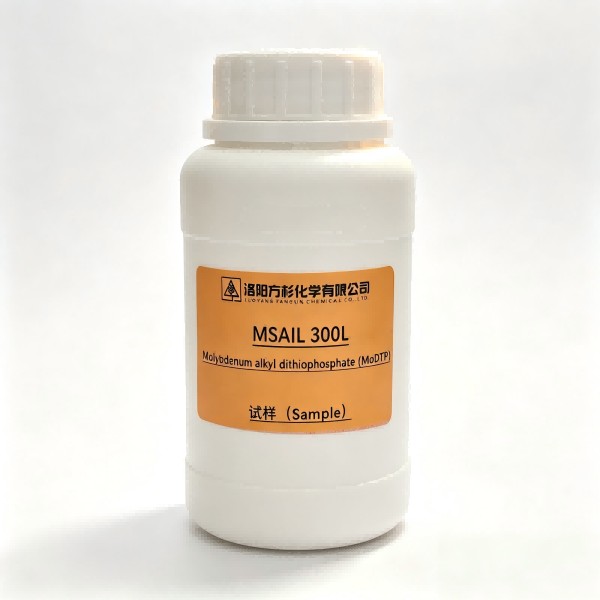
| Organic molybdenum | Molybdenum disulfide-type low-shear layers (with sulfur source) | Reduces friction coefficient as well as wear | Works best with a sulfur partner; not a stand-alone EP solution |
| Inorganic EP agents (grease) | Deposited protective layers | Support heavy-load grease where soluble additives are limited | Dispersion and thickener compatibility must be confirmed |
For sulfur-based work, sulphurised olefins psail 3540 is one example of the olefin type in our range. For balanced sulfur-phosphorus action, liquid triphenyl thiophosphate psail 2320 is a relevant reference. Where friction coefficient is the complaint rather than scuffing alone, organic molybdenum friction modifiers address a different part of the problem.
How Load, Temperature, and Base Oil Interact
No single parameter predicts film quality. These variables work together.
- Additive treat rate versus severity. A higher dose does not automatically give a thicker, better film. Past a point, you get more chemical wear and deposit rather than more protection. The right dose depends on the duty and the other components in the package.
- Anti-wear and EP competition. Phosphorus and sulfur species compete for the same surface sites. A package with both can outperform either alone, but only when the ratio is tuned. Poor balance can leave a large wear scar even though the weld load looks acceptable.
- Base oil polarity and viscosity. Polar base oils can compete with additives for surface sites. Viscosity affects how much oil film exists before contact, and therefore how often the reactive regime begins.
- Oxidation. Reactive sulfur compounds can decompose in hot, oxidizing oil before they reach the contact. Weak antioxidant performance therefore shows up as lost EP performance over time, not only as sludge.
- Water and contaminants. Moisture can hydrolyze some phosphorus species and weaken film formation.
Because these factors interact, a result from one oil and one test cannot be transferred to another formulation without checking. If operating temperature, load, base oil type, and metallurgy are not specified, a definitive additive selection is not possible. Those four inputs are the minimum a supplier needs from you.
Common Misunderstandings and How to Verify the Film
Mistakes that change the buying decision
- "Higher sulfur means better protection." Sulfur content shows how much reactive element is present, not how it behaves. The structure of the molecule controls activation severity.
- "A high weld load proves anti-wear performance." Weld load measures resistance to catastrophic failure. A small wear scar at moderate load measures a different thing. Both numbers are needed.
- "The film is permanent." It is sacrificial and consumed. Long drain intervals need an additive reservoir and oxidation stability to match.
- "Test data from different methods are interchangeable." Four-ball and SRV tests use different geometry, motion, and conditions. Compare results only within the same method and conditions.
Verification steps for a formulator
- Run the four-ball test and record PB (last non-seizure load) and PD (weld load) with a wear scar diameter at a fixed load.
- Run an SRV test to see friction coefficient and wear under oscillating contact at your intended temperature.
- Inspect the wear scar. A smooth, dark, uniform scar suggests film formation. A rough scar with scoring suggests the film is not forming or is being removed too quickly.
- Check oxidation performance after aging, then repeat a short EP test on the aged oil.
- Run a copper strip or similar compatibility check if yellow metals are present.
These tests establish whether a film forms and how well it holds. They do not establish field life; that needs a service trial.
A Worked Scenario: Screening for a Gear Oil with a Large Wear Scar
This is an illustrative scenario, not a customer case. A formulator blends an industrial gear oil. The four-ball test shows PB below target and a large wear scar, while friction coefficient in the SRV test is higher than expected.
| Observation | Likely reading | Next adjustment |
|---|---|---|
| PB below target, scar large | Film is not forming early enough, or phosphorus anti-wear is too weak | Add or rebalance a phosphorus component such as a phosphate amine salt EP/AW additive |
| PD low | Sulfur source is too mild for the severity | Test a more active sulfur type at a stepped dose |
| Friction coefficient high | Film is protective but has high shear resistance | Trial a friction modifier |
| Good fresh results, poor after aging | Oxidation is consuming the additive | Review antioxidant package |
Changing one variable per run keeps the cause visible. Teams that change three things at once lose the link between cause and effect.
Checks Before You Select, and How We Support Early-Stage Work
Before choosing chemistry, confirm the following:
- Operating load, temperature range, and speed at the critical contact
- Base oil type and viscosity grade
- Metallurgy, especially any copper alloys
- Target test method and pass criteria (PB, PD, SRV, oxidation)
- Whether you need single components or a pre-balanced package
Luoyang Fangshan Chemical was founded in 2017 and works as a professional lubricant additive manufacturer. Our R&D team includes more than 30 PhD and master's degree holders, and our functional chemical capacity exceeds 10,000 tons. The company operates under ISO 9001:2015, ISO 45001:2018, and ISO 14001:2015. For evaluation work, samples ship in 3 days and bulk orders in 7 days, with no MOQ. If a delivered product has a quality problem, return is handled through consultation.
Where a single additive will not balance your test results, high-performance lubricant additive packages let you start from a tuned ratio rather than building one from scratch. Duty-specific references are also collected on our solution and applications page.
If you are facing a high friction coefficient, weak EP results, a large wear scar, or PB/PD values that miss target, send us your base oil, test method, and target values. Our sales engineer, Eric Lee, can advise on component selection or request a sample for your bench test.
 WhatsApp
 Email
 +8616638861155