How to Source Thiadiazole tert-nonyl mercaptan condensate (DMTD-9) for Lubricant Blending
The sourcing mistake buyers regret most is approving a drug-like paper trail on a product that behaves differently in the blend. A drum labelled correctly, with a clean-looking certificate, can still arrive with a different grade, a different CAS entry or no batch link to the sample you tested. For Thiadiazole tert-nonyl mercaptan condensate, sold as DMTD-9 under CAS 91648-65-6, the identity check and the performance check must both be done before the first bulk order. This guide gives a procurement workflow you can use with any supplier, and explains where Luoyang Fangshan Chemical Co., Ltd. fits in it.
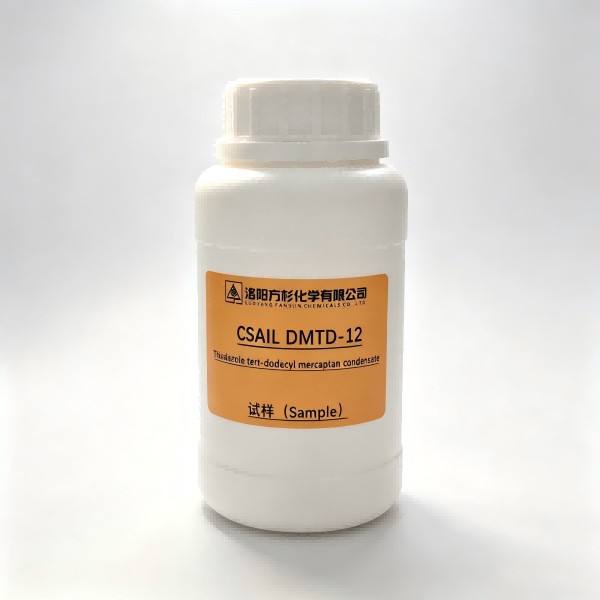
Where DMTD-9 sits in a lubricant formulation
DMTD-9 belongs to the family of thiadiazole-based metal corrosion inhibitors. Formulators typically evaluate this chemistry for yellow-metal protection, and sometimes for its contribution to antioxidant and extreme-pressure behaviour in industrial oils, gear oils and greases. It is a single additive component, not a finished package. That matters for sourcing, because you decide the treat rate and you carry the formulation risk.
A close relative is the DMTD-12 grade, listed as thiadiazole tert-nonyl mercaptan condensate CSAIL DMTD-12. The two names look similar on a quotation sheet, but they carry different CAS numbers and are different products. If a supplier quotes "DMTD" without a number, ask which grade before you compare prices.
Supplier role and fit
Fangshan Chemical is a professional manufacturer of lubricant additives, founded in 2017. Its range covers additive components and additive packages for industrial lubricants, and it positions its products as import-substitute additives for global markets. The company holds ISO 9001:2015 (quality), ISO 45001:2018 (occupational health and safety) and ISO 14001:2015 (environmental) certifications, and reports functional chemical production capacity above 10,000 tons. Its R&D team includes more than 30 PhD and master's degree holders.
What this means for a buyer: the fit is strongest if you are a blender or formulator looking for a single-component source that can also supply other components, or a ready package, from one place. You can browse the lubricant additive components and chemical additives range to see what else could consolidate into the same shipment. The fit is weaker if you need a finished, branded lubricant. This is an additive supplier.
A supplier-qualification checklist for DMTD-9
Use the table below before you release a purchase order. Each row names what to ask for, why it matters, and the limit of what the document proves.
| Item | What to request | Why it matters | Limit of the evidence |
|---|---|---|---|
| CAS identity | CAS 91648-65-6 on the quotation, COA, SDS and drum label | Prevents confusion with DMTD-12 (CAS 59656-20-1) and other thiadiazole derivatives | A matching CAS does not confirm performance. Only your blend test does that. |
| COA fields | Product name, grade, batch number, production date, test items with method and result, appearance | Lets you compare the sample COA against every later batch | A COA is the supplier's own data unless you run an incoming check. |
| Packaging | Pack size, drum material, label content, net weight, handling and storage notes | Affects transport, storage stability and decanting losses | Confirm the pack type for your volume. Do not assume it from a product page. |
| Sample approval | Sample labelled with batch number, plus its COA | Ties your lab results to a specific lot | One sample approves one lot. It does not approve the supplier's consistency. |
| Batch traceability | Batch number on COA, label and shipping documents, and retained-sample policy | Lets you trace a field complaint to a lot | Ask how long retained samples are held. Do not assume. |
| Management system | ISO 9001:2015, ISO 45001:2018 and ISO 14001:2015 certificates | Shows documented quality, safety and environmental controls | A certificate covers the system, not each batch's performance. |
Common mistakes this checklist prevents
- Comparing quotes by price per kilo only. Two products can share a name and differ in grade. Align CAS and COA fields first.
- Testing the sample but buying a different lot. Insist that the sample and the first bulk shipment share traceable batch documentation, or retest on arrival.
- Accepting a COA with no method listed. A number without a method cannot be reproduced in your lab.
- Skipping the SDS. Transport and handling rules depend on it, and it should match the CAS you ordered.
Validate performance before you commit
Paperwork tells you the product is what it says. Bench data tells you whether it works in your base oil. The brief for our technical team lists the failures formulators report most often: high friction coefficient, weak extreme-pressure response, large wear scar, PB/PD values below specification, poor SRV results and weak oxidation resistance. Design your trial around those exact symptoms.
| Concern | Typical test to run | What to compare |
|---|---|---|
| Yellow-metal protection | Copper strip corrosion (ASTM D130) | Rating at your treat rate against your current additive |
| Wear | Four-ball wear scar (ASTM D4172) | Scar diameter against your baseline blend |
| Extreme pressure | Four-ball EP (ASTM D2783), PB/PD values | Weld point and load-wear index against your target |
| Friction | SRV test | Friction coefficient trace under your load and temperature |
| Oxidation | RPVOT (ASTM D2272) or your in-house method | Time to pressure drop against baseline |
Run the baseline and the DMTD-9 blend in the same session, on the same base oil lot. Where a sulfur or phosphorus EP/AW additive is already in your formula, check for interaction, because thiadiazole chemistry can shift the response. Options such as oil-soluble sulfur-based EP/AW additives or phosphate amine salt EP/AW additives are worth testing alongside it when the single component does not close the gap.
If DMTD-9 alone does not meet your targets, a tuned package may be a more practical route. See the lubricant additive packages and blending solutions for hydraulic, gear, compressor and turbine oils.
Step-by-step sourcing workflow
- Define the target. Write down the base oil, treat-rate range, and the pass/fail values for the tests above.
- Request identity documents. Ask for the product page or specification, CAS confirmation, SDS and a sample COA. Check the CAS against 91648-65-6.
- Order a labelled sample. State the grade, the batch requirement and the intended use. The company states that samples are dispatched within 3 days.
- Test in your blend. Run the baseline comparison. Record the batch number next to every result.
- Agree the commercial terms in writing. Packaging, incoterms, documents per shipment, and the acceptance criteria for incoming lots.
- Place the first bulk order and run an incoming check. Compare the delivered batch COA with your sample COA, and retest one or two key properties. The company states bulk orders are dispatched within 7 days. Confirm the actual date against your quantity and destination when you order.
Cooperation terms and boundaries
Supplied terms that bear on a trial order: there is no minimum order quantity, so you can order a small lot for pilot blending rather than committing to a drum count you cannot use. Lead times are as stated above. If a delivered product has a quality problem, returns are handled by negotiation between the parties.
Several items are not covered by supplied facts and should be agreed before ordering:
- The exact specification limits for the lot you will receive.
- The acceptance window after arrival, and who pays for retesting.
- The documents that travel with each shipment.
- Pack sizes and the pricing breakpoints for your volume.
Settling these up front keeps the "negotiated return" route short if a lot fails your incoming check.
When DMTD-9 is not the right answer
DMTD-9 is a performance additive, so it will not repair a poor base oil or a mismatched formula. If your main problem is rust on ferrous parts, the better starting point is rust inhibitors for black metals. If you need friction reduction, look at organic molybdenum friction modifiers. If your priority is a water-based metalworking fluid, the metalworking fluid additives range is a more appropriate place to start. A short call with a technical sales engineer can save a trial round by pointing you to the right chemistry first.
Next step
If you are comparing sources for DMTD-9, send us your target application, base oil type, expected treat rate and annual volume. We will confirm grade and CAS, share the specification and COA format, and arrange a labelled sample for your lab. You can also read more about us as a professional lubricant additive manufacturer before you reach out. To start, request a sample or quote for DMTD-9 (CAS 91648-65-6).
— Eric Lee, Sales Engineer, Luoyang Fangshan Chemical Co., Ltd.
 WhatsApp
 Email
 +8616638861155