Metal Deactivators and the Chelation vs Passivation Choice
When a formulation fails a copper corrosion test or oxidizes too fast, which kind of fix does it need: one that ties up dissolved metal ions, or one that coats the metal surface? Metal deactivators are often specified as a single category, yet the two mechanisms behind them respond to different problems. Treating them as interchangeable is where many screening programs lose weeks.
This article separates the two mechanisms and shows how they diverge in real fluids. It is written for R&D teams narrowing options before lab screening.
What is actually known, and where the evidence stops
Two observations are well established in lubricant chemistry. First, dissolved or suspended copper, iron and other transition-metal species can catalyze oxidation of the base oil. Second, active sulfur-bearing chemistry, including some EP agents, can attack yellow metals such as copper and brass and leave stains or corrosion products.
From those two observations, the industry usually draws two interpretations. One says to neutralize the metal ion in the bulk fluid, which is chelation. The other says to protect the metal surface so it cannot release ions or react, which is surface passivation. Both interpretations are reasonable, but they are interpretations. A single bench result rarely proves which mechanism did the work.
Scope matters here. This article is an evergreen technical comparison. It does not report a market shift, and no dated source is cited. Nor do we claim that one mechanism is replacing the other. Real additives often show both behaviors to some degree. Triazole and thiadiazole chemistry, for example, is mainly applied as a surface film former on yellow metals, but it can also interact with metal species in solution.
Comparison: chelation versus surface passivation by metal source, fluid, temperature and substitution risk
The table maps the two approaches against the variables that most often decide the outcome. Treat it as a first filter, not a verdict.
| Factor | Chelation (bulk-phase) | Surface passivation (film-forming) |
|---|---|---|
| Where it acts | In the fluid, on dissolved or suspended metal ions | At the metal surface, forming a protective adsorbed layer |
| Typical metal source | Wear metals, catalytic ions carried in from the system, contamination | Copper, brass and other yellow-metal components in contact with the fluid |
| Main problem addressed | Metal-catalyzed oxidation, sludge, and viscosity growth | Copper strip staining, sulfur-induced corrosion, and ion release from the surface |
| Fluid type fit | Fluids that circulate for long periods and accumulate wear metals: turbine, hydraulic, compressor oils | Fluids with active EP chemistry or yellow-metal hardware: gear oils, greases, metalworking fluids |
| Temperature exposure | Depends on the stability of the metal-chelate complex under sustained heat | Depends on film adsorption strength; hot, high-shear contact can strip or compete with the film |
| Competing additives | Interacts with antioxidants and with polar additives that also bind metals | Competes with AW/EP additives for surface sites, which can change friction and wear results |
| Risk if swapped | Using a chelator alone on a copper surface under active sulfur may still leave staining | Using a passivator alone on a high-wear-metal system may leave bulk oxidation uncontrolled |
Our reading of the last row: substituting one for the other does not produce an obvious failure at first. The test that was written to catch the problem passes, and the other failure mode shows up later in the service life or in a different test.
Drivers, and the alternative explanations to rule out
When a team reports that "the deactivator did not work," at least four explanations compete.
- Mechanism mismatch. A surface-active additive was chosen for an ion-driven oxidation problem, or the reverse.
- Additive interaction. The passivating film competes with phosphorus or sulfur AW/EP chemistry. The corrosion result improves while wear scar, PB/PD value or SRV friction coefficient worsens. These symptoms are easy to blame on the EP agent when the cause is surface competition.
- Base oil and dosage effects. Solubility, polarity and treat rate change how much additive reaches the surface or stays in solution.
- Test design. A short static copper-strip test and a long oxidation test measure different things. A pass in one is not evidence of mechanism.
The practical conclusion is to change one variable at a time and read at least one test aimed at the surface and one aimed at the bulk fluid. This does not apply when the system has no copper alloys and no sulfur-bearing EP agent. In that case, the passivation question may be irrelevant and an antioxidant-first approach is the sounder starting point.
Where each approach fits by application
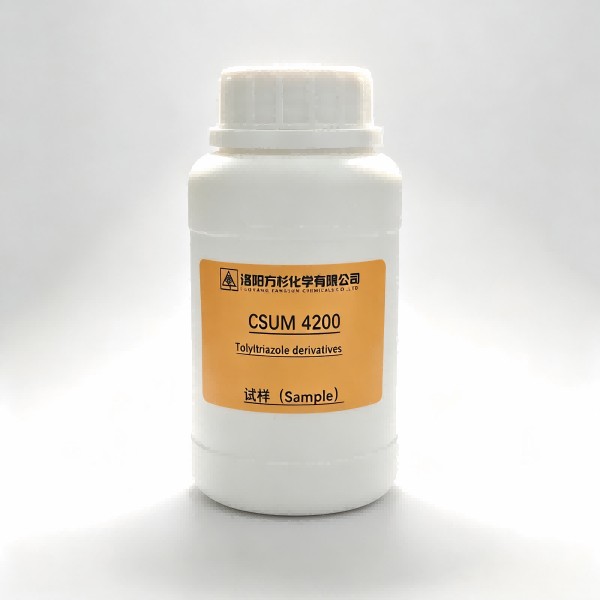
For yellow-metal protection in formulations containing active sulfur, film-forming chemistry is typically the first screen. Our range includes thiazole-based metal corrosion inhibitors and deactivators, with grades such as triazole derivatives CSAIL 3000. For sulfur-rich systems, thiadiazole-based metal corrosion inhibitors are another route, and they also bring some antiwear contribution.
For circulating industrial oils where oxidation stability is the pass/fail criterion, the question moves to the package level. The deactivator, the antioxidant and the rust inhibitor have to be balanced together, which is why complete systems such as hydraulic oil additive packages are built and tested as a unit rather than additive by additive.
Limits: this mapping is a starting hypothesis. Fluids with unusual base stocks, high water content or very high bulk temperatures can shift the answer, and lab data should decide.
A worked scenario: gear oil with copper-alloy components
This is an illustrative scenario, not a customer case.
A formulator is developing an industrial gear oil with a sulfur-based EP additive. Bronze components are present. The prototype passes the extreme-pressure target but stains the copper strip. The team adds a chelating additive and the staining barely changes, because the problem is surface attack, not dissolved ions.
They then switch to a film-forming triazole or thiadiazole type. The strip improves, but the SRV friction coefficient rises and the wear scar grows slightly. The film is now competing with the EP chemistry for surface sites. The response is to lower the passivator dose in steps, rerun the EP and wear tests at each step, and look for the lowest dose that clears the copper test.
Result: the answer is a dose window, not a product swap. The lesson applies to most surface-active combinations.
Step-by-step screening procedure
- Define the failure. Write down whether the problem is a copper corrosion rating, oxidation growth, sludge or a wear and friction result.
- Identify the metal source. List the yellow-metal hardware, likely wear metals and any known contamination.
- Pick one mechanism hypothesis. Choose chelation, passivation or a combination, and state the test that would disprove it.
- Screen at three dose levels. Use a low, a medium and a high treat rate, keeping the rest of the formulation fixed.
- Read both sides. Run a surface test (copper strip, rust or corrosion test) and a bulk test (oxidation stability). Add wear scar, PB/PD and SRV friction checks when EP/AW chemistry is present.
- Check thermal and storage stability. Confirm that the film or complex survives the temperature profile and that the additive stays in solution.
Common mistakes in metal-deactivation selection
- Reading a copper-strip pass as proof that oxidation is under control.
- Raising the passivator dose to fix corrosion without rechecking wear and friction.
- Choosing by price per kilogram instead of by dose required to clear the specific test.
- Assuming one additive covers both mechanisms across every base oil.
- Testing in a clean laboratory fluid and ignoring wear-metal accumulation in service.
Supplier questions that change the decision
| Question to ask | Decision it affects |
|---|---|
| Is the additive mainly film-forming, mainly chelating, or both, and what data shows it? | Whether it fits a surface problem or a bulk oxidation problem |
| How does it behave alongside phosphorus and sulfur EP/AW agents? | Whether wear scar, PB/PD and SRV results will hold |
| What is the recommended dose window, and what happens above it? | Cost and risk of over-treatment |
| Can the supplier adjust the whole package, not only the single additive? | Whether you can resolve interaction problems quickly |
On the supply side, we are a professional lubricant additive manufacturer established in 2017, with an R&D team of more than 30 PhD and master's degree holders and functional-chemical production capacity above 10,000 tons. Our quality, occupational health and environmental management systems are certified to ISO 9001:2015, ISO 45001:2018 and ISO 14001:2015. Samples ship in 3 days and bulk orders in 7 days, with no MOQ, which allows a small screening matrix without committing to volume. Where a delivered product has a quality problem, we handle the return by agreement.
One open uncertainty remains. Whether a given additive acts chiefly through chelation or through a surface film often has to be inferred from indirect tests. If your results suggest both, the practical response is to treat the pair of additives as a system and test them together.
If you are comparing options for a specific fluid, send us your base oil, metal hardware and target tests. We can suggest a short screening list and provide samples for the first round. Selection advice is available through our lubricant additive packages and blending solutions team.
 WhatsApp
 Email
 +8616638861155