How to Optimize Oleic Acid Imidazoline for Brine Corrosion
Why does the same inhibitor protect carbon steel in one brine and fail in another that looks almost identical on paper? The answer usually sits in five variables: dosage, salinity, pH, temperature and contact time. Oleic acid imidazoline is a film-forming, nitrogen-based corrosion inhibitor. Its protection depends on whether a stable adsorbed layer forms on the metal before the brine attacks it. This article is for formulators and technical buyers who need to validate that behavior in a specific brine before they select a grade.
What the inhibitor does in a brine system
The imidazoline ring carries a polar nitrogen head. The oleic hydrocarbon tail is long and oil-loving. In a brine the head group adsorbs on the steel surface and the tails pack outward, forming a hydrophobic barrier that slows both water contact and ion transport. The film is not a coating you apply once. It is a dynamic equilibrium: molecules adsorb, desorb and are replaced from the bulk fluid.
That has three practical consequences.
- Bulk concentration matters continuously. If the inhibitor is consumed, partitioned into oil or stripped by solids, the film thins.
- Surface condition matters. Mill scale, existing rust and deposits block adsorption sites.
- Chemistry matters. Imidazolines can hydrolyze toward amide species in hot, water-rich conditions, which changes film behavior over long exposure.
Limit: this mechanism describes corrosion under CO2 or chloride attack on carbon steel. It does not make the product a universal answer for oxygen-driven pitting or strong acid stimulation fluids, which need separate evaluation.
How dosage, salinity, pH, temperature and contact time affect film formation
This is the core of any brine validation. Treat each variable as a test axis, change one at a time, and record the failure mode. The table summarizes the direction of each effect, what to check and the usual reason a test fails.
| Variable | How it affects the film | What to check | Common failure reason |
|---|---|---|---|
| Dosage | Too low leaves bare patches. Too high can cause emulsions, foaming or carry-over without added protection. | Run at least three or four levels around the supplier's suggested range and plot corrosion rate against dose. | Testing only one dose, then assuming linear improvement. |
| Salinity | Higher chloride and divalent ions change solubility, dispersion and surface charge, which shifts adsorption and partitioning. | Use the real brine composition, including calcium, magnesium and sulfate, not a plain sodium chloride solution. | Lab brine too simple; field brine salts destabilize the dispersion. |
| pH | Low pH protonates the nitrogen head and favors adsorption on the metal, but it also raises general attack. Higher pH can reduce solubility. | Test at the lowest and highest pH the system will see in service. | Single pH test; excursions in the field leave the film exposed. |
| Temperature | Heat speeds adsorption but also speeds desorption and hydrolysis, and it changes oil/water partitioning. | Test at operating temperature and at a realistic upper excursion. Run long enough to see rate drift. | Short hot test passes, long hot test fails as the film degrades. |
| Contact time | Film builds over time. Early readings show a high corrosion rate that falls as coverage improves. | Log rate versus time, not only the final weight loss. | Judging by a short exposure, or ignoring the pre-filming step. |
Executable steps for each variable
- Fix the brine first. Use the actual salt composition and dissolved gas (CO2, H2S or none). Checkpoint: record conductivity and pH before every run. Failure reason: swapping brine batches mid-study.
- Sweep dosage. Keep temperature, pH and time constant. Checkpoint: find the dose where corrosion rate stops improving; the useful dose sits at the start of that plateau. Failure reason: ignoring dispersion quality at the high end.
- Sweep salinity and pH around the real operating point. Checkpoint: any step change in rate signals a stability problem, not just a dosing problem. Failure reason: pH drift from CO2 loss during the test.
- Run temperature and time together. Checkpoint: compare early and late rates. A rising late rate points to film breakdown. Failure reason: sealing the cell badly so oxygen enters.
- Test a pre-filming step if the system allows. A higher initial dose for a short period, followed by a maintenance dose, often builds coverage faster. Checkpoint: compare against continuous dosing at the same total consumption.
Limit: these steps validate performance in a lab cell. Flow, solids and multiphase turbulence in the field can shear a film, so a rotating cylinder or flow loop test is the better second stage for high-shear service.
A validation procedure that holds up in procurement review
Corrosion numbers from a single method rarely convince a technical committee. Combine methods so each covers the other's blind spot.
- Coupon weight loss (static, following a recognized practice such as ASTM G31 or equivalent). It gives an averaged rate and shows pitting visually.
- Linear polarization resistance for rate versus time. It shows how quickly the film forms.
- Rotating cylinder or flow test where shear is part of the real service.
- Compatibility check with the rest of the formulation: emulsion tendency, foaming, haze, deposit formation and effect on seals or paints, where relevant.
- Blank and benchmark runs alongside the candidate. A benchmark is the incumbent inhibitor, so the comparison is on the same brine and the same day.
Acceptance criteria should be written before testing: target corrosion rate, localized attack limit, and no phase separation or foaming at the intended dose. This prevents post-hoc rationalization.
Common mistakes that distort brine results
- Using a synthetic brine that is too clean. Real produced or process brines carry divalent ions, iron and solids that change adsorption.
- Judging by 24 hours. Early rates exaggerate the problem, and long runs expose hydrolysis and desorption.
- Overdosing to compensate for poor dispersion. More product can create emulsions without improving the film.
- Skipping surface preparation consistency. Coupons with different roughness or rust give scatter larger than the effect you are measuring.
- Ignoring oil phase. If hydrocarbons are present, the inhibitor partitions between oil and water, and the water-phase concentration may be lower than the dose suggests.
- Treating the inhibitor as stand-alone. Scale, oxygen and microbial issues sit beside it and need their own control.
Choosing a grade and supporting chemistry
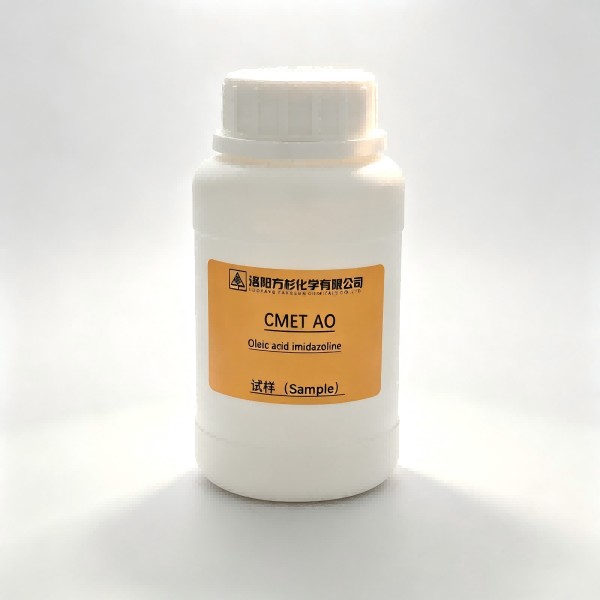
Imidazoline inhibitors differ in tail structure, acid or salt form and solvent carrier. Those differences change oil solubility and water dispersibility, which is why one grade suits a lubricant or oil-continuous system and another suits a water-rich one. If you are screening candidates, start with the CMET AO inhibitor (CAS 95-38-5) and compare it with a salt-type alternative such as heptadecenyl imidazoline succinate CMET T703. The wider rust inhibitor for black metals range includes sarcosinate and succinate types that can be evaluated in parallel.
| Situation | Reasonable approach | When it does not apply |
|---|---|---|
| Carbon steel in chloride brine with CO2 | Imidazoline-type film former, dose-swept in the real brine | Oxygen-dominated corrosion; add oxygen control first |
| Mixed metals including copper alloys | Pair with a yellow-metal protector such as the thiazole-based metal corrosion inhibitors | Ferrous-only systems |
| Lubricant or grease with water ingress | Evaluate within a finished lubricant additive package for compatibility with EP and anti-wear components | Neat brine systems with no oil phase |
A worked scenario for planning your test matrix
This is an illustrative planning example, not a customer case. Suppose a formulator must protect carbon steel in a chloride-rich brine at elevated temperature, with an occasional pH dip. A workable plan:
- Round one: four dose levels at operating temperature and normal pH, 72 hours, coupons plus LPR.
- Round two: the chosen dose at low pH and at the upper temperature excursion, comparing early and late rates.
- Round three: pre-filming versus continuous dosing at equal total consumption.
- Round four: flow test and compatibility check for foaming, haze and emulsion.
The deliverable is a short table: dose, conditions, corrosion rate, localized attack note, side effects. That table is what procurement and quality teams need to sign off.
Buyer's checklist before selection
- Does the supplier provide a technical data sheet and a sample for your own brine test?
- Has the dose range been tested in your salinity, pH and temperature window, not only a generic one?
- Are foaming, emulsion and deposit behavior recorded?
- Is batch consistency supported by a documented quality system?
- Is there a clear route for handling a quality dispute?
On the supply side, Luoyang Fangshan Chemical Co., Ltd. operates under ISO 9001:2015, ISO 45001:2018 and ISO 14001:2015 management systems. Production capacity for functional chemicals exceeds 10,000 tons, and an R&D team of more than 30 PhD and master's degree holders supports formulation and testing questions. Samples ship within 3 days and bulk orders within 7 days, with no MOQ, so a small validation batch is practical. If a product quality problem occurs, return is handled through negotiation. You can read more about us as a professional lubricant additive manufacturer, and the range of lubricant additive components is available for companion chemistry.
If you are screening an imidazoline inhibitor for a specific brine, send us your salinity, pH, temperature and base fluid details. We can recommend a grade and supply a sample for your test matrix.
 WhatsApp
 Email
 +8616638861155