How Trioctyl Phosphate Improves PVC Flexibility in Real Formulations
Why does a phosphate ester soften a rigid polymer like PVC, and why does it stay flexible when the temperature drops? Trioctyl phosphate (tris(2-ethylhexyl) phosphate, CAS 78-42-2) answers both questions through its molecular shape and its polarity. This article explains the mechanism, shows what happens when key parameters are chosen badly, and gives a test procedure formulators can run before committing to a grade.
What Plasticization Actually Does Inside PVC
Unplasticized PVC is stiff because its chains are held together by dipole attraction between carbon-chlorine bonds. Those polar sites lock neighboring chains in place. A plasticizer works by moving between the chains and replacing some of that chain-to-chain attraction with chain-to-plasticizer attraction. The chains slide more easily, the glass transition temperature drops, and the compound bends instead of cracking.
Two features of a plasticizer molecule do the work:
- A polar head. The phosphate group interacts with the polarized C-Cl sites. This anchors the molecule in the resin so it does not simply sit in pockets and bleed out.
- Non-polar side arms. The three branched 2-ethylhexyl groups keep the chains apart and add free volume. Branching also disrupts packing, which is why the molecule stays fluid at low temperatures.
Trioctyl phosphate has both features in a good balance. That is the reason formulators consider it a phosphate ester plasticizer for applications where low temperature flexibility matters as much as room temperature softness.
How Molecular Compatibility and Low Temperature Behavior Enable Plasticization in PVC and Cellulose Nitrate
This is the section that separates a working formulation from a sweating, brittle one. Compatibility decides whether the plasticizer stays inside the polymer. Low temperature behavior decides whether the compound still flexes in a cold warehouse or an outdoor cable run. Both polymers need a polar interaction site, but they use it differently.
| Factor | In PVC | In cellulose nitrate | What goes wrong if misjudged |
|---|---|---|---|
| Polar interaction site | C-Cl dipoles on the chain | Nitrate ester and residual hydroxyl groups | Weak interaction leads to exudation (oily surface) after storage |
| Role of branched octyl groups | Add free volume and lower chain stiffness | Break up tight cellulose chain packing, reducing film brittleness | Too little plasticizer gives cracking; too much gives tackiness and softness loss under load |
| Low temperature behavior | Branched chains resist crystallizing or thickening, so the compound stays pliable in the cold | Films and coatings resist cracking on flexing at low temperature | A poorly matched plasticizer stiffens early, causing cable jacket splits or coating checking |
| Role in the blend | Often paired with a primary plasticizer to tune cost, flame resistance and cold flex | Used to adjust film flexibility and flame behavior | Using it alone without checking compatibility limits can shorten service life |
Compatibility is not a yes-or-no property. It has a ceiling. Below that ceiling the plasticizer stays dissolved in the resin. Above it, the excess migrates to the surface. So the practical conclusion is to test loading ladders rather than copy a single recipe from another resin grade. The reasoning is that K-value, stabilizer package, filler level and processing history all move the ceiling. This applies to PVC and cellulose nitrate alike. It does not replace validation for your own resin, because supplier-specific resin and stabilizer differences can shift results.
Parameters That Decide Whether the Compound Performs
It helps to know what each variable actually affects, not just its name.
| Parameter | What it controls in practice | Consequence of getting it wrong |
|---|---|---|
| Loading level | Hardness, elongation, cold bend performance | Too low: stiff, cracks at joints. Too high: surface bloom and reduced tensile strength |
| Blend ratio with primary plasticizer | Balance of cost, flame behavior and low temperature flexibility | An unbalanced ratio can lose the cold-flex advantage or increase migration |
| Purity and acid value | Heat stability and electrical behavior | Residual acidity can speed up PVC dehydrochlorination and cause yellowing |
| Moisture content | Processing quality | Moisture leads to voids, haze or surface defects in extruded and calendered products |
| Volatility at processing temperature | Weight loss during mixing, fusing and long service at heat | Hardening over time in hot environments and fogging in enclosed spaces |
| Heat stabilizer system | Protects PVC during processing | A mismatch between stabilizer and ester can cause early discoloration |
One note on limits: TOP does not give the same flame resistance as aryl phosphates, because its alkyl structure burns more readily than a tricresyl or trixylyl structure. If a flame rating drives your specification, it should be one component of the system, not the whole answer.
Where Alkyl and Aryl Phosphates Fit Differently
Choosing between phosphate esters is a trade between cold flexibility and flame or permanence performance. The comparison below reflects the general chemistry of the families, not a guarantee for any single grade.
| Option | Typical strength | Typical limitation | Best fit |
|---|---|---|---|
| Alkyl phosphate such as TOP | Good low temperature flexibility, easy processing | Lower flame resistance than aryl types; higher volatility concern at long high heat exposure | Cold-climate flexible PVC, films and coatings that must keep bending in the cold |
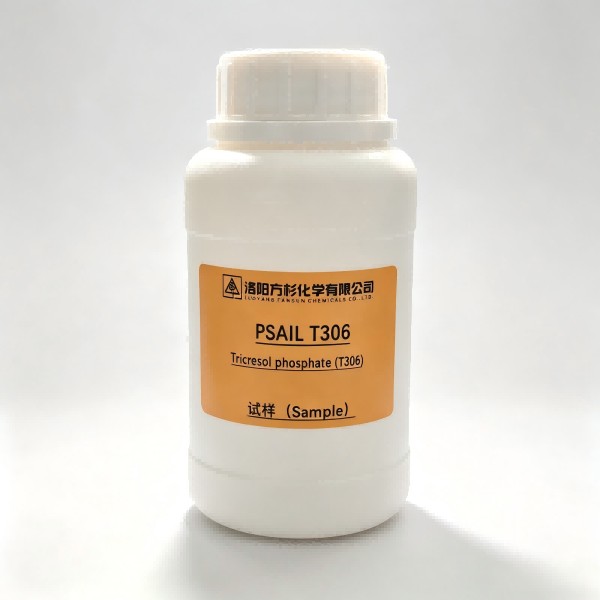
| Aryl phosphate such as tricresyl phosphate PSAIL T306 | Stronger flame resistance and lower migration tendency | Stiffer at low temperature | Compounds where flame behavior sets the specification |
| Aryl phosphate such as trixylyl phosphate PSAIL 3220X | Balanced flame resistance and permanence | Less cold flexibility than alkyl types | Mixed systems where both flame and permanence matter |
Many formulators blend an alkyl and an aryl phosphate to bring the cold-flex and flame properties into one compound. A blend of that kind needs its own validation. Do not assume the properties average out neatly.
Common Mistakes When Specifying a Phosphate Plasticizer
- Testing only at room temperature. A compound that bends well at 23 °C can still crack in a cold chain. Always include a low temperature flex or brittleness check.
- Ignoring migration. Surface oil after storage or contact with other plastics is a compatibility failure, not a cosmetic issue. Run contact tests against the actual neighboring material.
- Judging by hardness alone. Two compounds with the same Shore reading may behave differently in the cold and under heat aging.
- Skipping acid and moisture checks. These two values often explain yellowing and voids that get blamed on the resin.
- Treating a lubricant additive grade as a plastics grade by default. Confirm with the supplier that the grade, its purity and its documentation suit your polymer application and your regional regulatory requirements.
A Practical Evaluation Procedure
- Define the failure you fear most. Cold cracking, exudation, flame rating or yellowing. This sets which tests carry the most weight.
- Prepare a loading ladder. Make three or four batches with increasing plasticizer content, keeping resin, stabilizer and filler constant.
- Add a blend arm. Repeat the middle loading with a partial replacement by your current primary plasticizer.
- Measure the basics. Hardness, elongation, tensile strength, and a low temperature flex or brittleness test.
- Age the samples. Hold at elevated temperature, then re-measure weight loss and hardness. Store pressed sheets between sheets of the contact material to check migration.
- Check color and surface. Look for yellowing, haze and surface oil after aging.
- Select the lowest loading that meets the cold-flex target. This keeps cost and migration risk down.
Sourcing Notes for Formulators
Luoyang Fangshan Chemical Co., Ltd. was founded in 2017 and works as a professional lubricant additive manufacturer. Our R&D team includes more than 30 PhD and master's degree holders, and our functional chemicals capacity exceeds 10,000 tons. Quality, environmental and occupational safety systems are certified to ISO 9001:2015, ISO 14001:2015 and ISO 45001:2018.
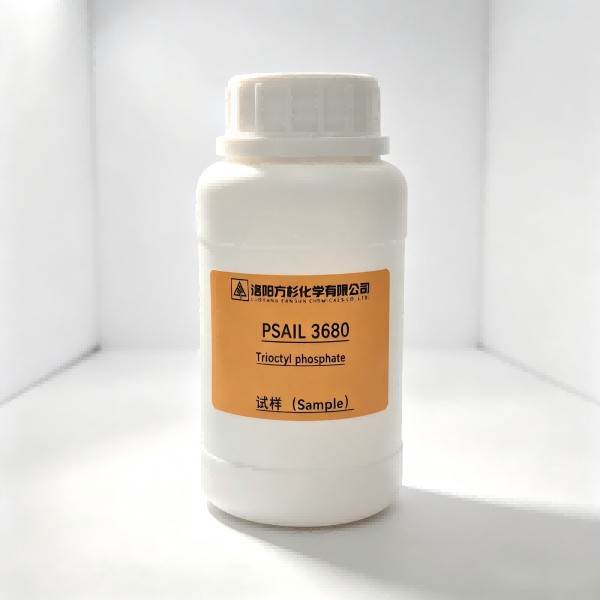
Our range centers on lubricant and oil additives, so the phosphate esters we list are positioned for lubricant use first. The trioctyl phosphate PSAIL 3680 page lists the product, and the wider phosphate ester additives category shows related options. If your project is a flexible polymer application, tell us the resin, target service temperature and regulatory needs so we can discuss whether a grade fits before you order.
On logistics: samples ship within 3 days, bulk orders within 7 days, and there is no minimum order quantity. That makes a small loading ladder trial practical. If a delivered product has a quality problem, we handle the return by agreement.
To compare grades or request a sample for your own loading ladder, send us your resin type, target hardness and lowest service temperature, and our technical team will respond with selection advice.
 WhatsApp
 Email
 +8616638861155