How to Verify 2,5-Dimercapto-1,3,4-thiadiazole (DMTD) Identity by IR and NMR
Can an incoming DMTD lot be released for formulation work based on a supplier label, melting behavior, or visual inspection alone? No. For lubricant-additive formulators and quality control teams, identity confirmation should begin with a matched infrared spectrum and an NMR profile that agrees with the expected thiadiazole structure and does not show warning signs of moisture, oxidation, or foreign organic material.
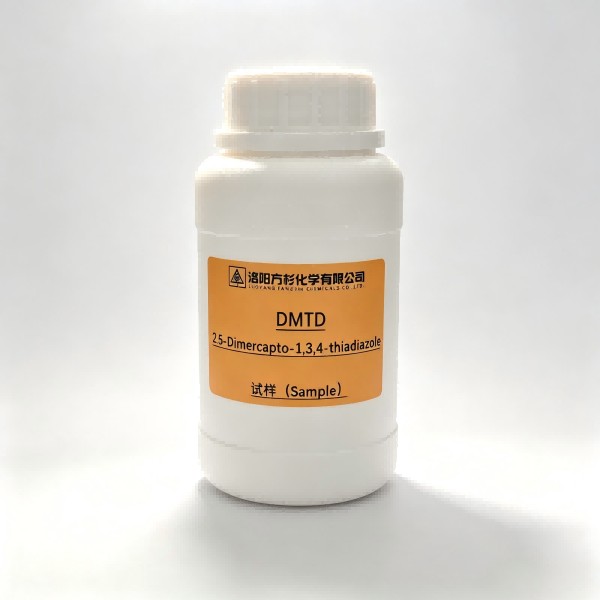
2,5-Dimercapto-1,3,4-thiadiazole (DMTD) is used as a sulfur and nitrogen containing building block in metal deactivation and corrosion-control chemistry. Its molecular form, tautomeric behavior, sample handling, and limited solubility can complicate interpretation. A weak or broad signal is not automatically proof of poor quality. Equally, a clean-looking spectrum does not prove that the material will perform correctly in a finished lubricant.
The practical objective is narrower: confirm whether the received material is consistent with the expected chemical identity, identify obvious contamination or degradation, and decide whether the lot can move to formulation screening. This article gives a release-oriented approach rather than a theoretical spectroscopy lesson.
Set the acceptance question before collecting spectra
Start by defining what the IR and NMR review must answer. If the question is only “does this sample contain a thiadiazole compound,” a quick IR overlay may be sufficient. If the question is “can this lot enter a high-value gear oil, hydraulic oil, or metalworking formulation,” use both techniques and retain a representative reference spectrum from an approved material.
The correct conclusion depends on the use case:
- Incoming identity release: Use IR as the fast comparison tool, then use NMR to resolve uncertainty. This fits routine receipt inspection when an approved reference sample is available. It does not replace purity testing where trace contamination can affect color, odor, copper response, or storage stability.
- Supplier qualification: Compare multiple lots rather than a single retained sample. This identifies whether a supplier’s process gives consistent fingerprints. It does not establish finished-oil compatibility without blend testing.
- Failure investigation: Test both the retained incoming sample and material recovered from a blend if possible. This fits unexpected corrosion protection changes or abnormal deposit formation. It may not identify every low-level contaminant because IR and NMR have different detection limits.
- Formulation change control: Apply the same spectral review when changing source, packaging, solvent history, or handling method. This is useful before a replacement additive is approved. It cannot be used as a shortcut for full performance validation.
A receiving team should also record the sample condition before opening the vial: package integrity, visible color variation, odor, powder texture, and evidence of clumping. These observations are supporting evidence, not identity proof. Moisture pickup and oxidation can alter handling properties before their signals become obvious in a routine spectrum.
Our technical work is supported by a research team of more than 30 PhD and master’s degree holders, with development covering single additives, package design, formulation optimization, and performance testing. For buyers, that matters because an identity decision should be connected to the next technical question: whether the chemistry is suitable for the intended oil system, metal surface, and additive package.
Build an IR fingerprint around functional groups and sample condition
Infrared spectroscopy is usually the fastest first-pass method for incoming material verification. DMTD has a heterocyclic sulfur and nitrogen structure, so the useful review is not a search for one isolated peak. Instead, compare the entire fingerprint region, the bands associated with ring bonding, the sulfur-related pattern, and any broad absorption that may indicate absorbed water or altered chemistry.
Use an approved reference material prepared in the same way as the incoming sample. If one sample is analyzed as a dry solid and the other is analyzed from a different preparation method, differences caused by crystal packing, water exposure, or contact quality can be mistaken for a chemical change.
What to look for in the expected IR pattern
- Ring bonding pattern: The expected spectrum should show a consistent group of absorptions associated with the nitrogen and sulfur containing thiadiazole ring. The conclusion is stronger when the overall fingerprint overlays the reference rather than when a single band appears similar. This fits routine identity matching. It does not prove that the sample is free from a small amount of structurally similar material.
- Sulfur hydrogen behavior: DMTD may exist in tautomeric forms, and hydrogen associated with sulfur can be weak, broadened, or affected by intermolecular association. Do not reject an otherwise matching sample merely because this feature is not sharp. Reject or investigate when the full spectral pattern changes, not when one exchange-sensitive feature varies.
- Water related broad absorption: Broad features associated with water can indicate moisture pickup from storage, transfer equipment, or sample preparation. This matters because water can affect powder flow, apparent assay, solubility behavior, and downstream blending control. A water signal alone does not identify the source or quantify the moisture level.
- New carbonyl related absorption: A clear new carbonyl pattern is not expected for the target structure. It may indicate oxidation products, residual process materials, contamination from a solvent, or contact with a foreign additive. This warrants hold status and follow-up testing. It does not identify the exact contaminant without further analysis.
For a quick release check, run the reference and unknown under the same instrument method, normalize the spectra consistently, and overlay them. Then inspect the difference spectrum. A visual side-by-side review without an overlay often misses small but meaningful changes.
When working with related products, distinguish the base material from modified thiadiazole chemistry. For example, dmtd additives for lubricant may include reaction products designed for different solubility, compatibility, or metal-protection roles. Their spectra should not be assumed to match unmodified DMTD.
A spectral comparison of expected IR and NMR markers versus common moisture, oxidation, and impurity signals
The table below is intended for technical screening, not as a substitute for an approved specification. The main risk is misreading a nonideal spectrum. A moisture signal can be treated as oxidation, an exchangeable proton can be treated as missing identity, or a solvent residue can be treated as a new process impurity. Each interpretation drives a different purchasing and release decision.
| Condition under review | Expected IR observation | Expected NMR observation | What it affects in practice | Recommended action and limit |
|---|---|---|---|---|
| Expected DMTD identity | Consistent thiadiazole ring fingerprint and sulfur containing pattern when overlaid with approved reference material. | Simple proton profile because the ring has no ordinary carbon hydrogen; exchangeable sulfur hydrogen may be broad or variable. Carbon NMR should be structurally simple because of molecular symmetry. | Supports correct material selection before corrosion inhibitor or metal deactivator formulation trials. | Release only when both techniques agree with the approved reference. Spectral agreement does not alone establish purity or finished-oil performance. |
| Moisture exposure | Broader water associated absorption, potentially superimposed on the expected profile. | Water signal may appear depending on solvent and handling; exchangeable features may broaden or shift. | Can change powder handling, weighing consistency, dissolution behavior, and the interpretation of assay results. | Dry or resample under controlled handling, then compare again. IR and NMR cannot determine whether moisture came from manufacturing, packaging, or laboratory preparation. |
| Oxidation or altered sulfur chemistry | New or strengthened oxygen containing features, especially a carbonyl or sulfur oxygen related pattern absent from the reference. | Additional resonances may appear if oxidation creates new organic environments; a more complex profile is a warning sign. | May weaken expected metal-surface interaction or introduce compatibility risk in an additive package. | Place the lot on hold and use targeted confirmatory testing. Do not assign a specific oxidation product from a single unexplained band. |
| Residual organic solvent | Extra solvent-like bands not present in the approved reference. | Sharp, recognizable signals beyond the sparse expected DMTD profile. | Can distort apparent concentration, create odor, affect flash-related handling decisions, or change blend behavior. | Compare with a solvent library and request supplier process information. NMR is especially useful here, but a small residue may require a more sensitive method. |
| Foreign organic impurity | Additional fingerprint bands or altered relative intensity across several regions. | Unexpected nonexchangeable proton signals or multiple additional carbon environments. | Can alter solubility, corrosion protection, color, or interaction with other additives. | Hold and investigate with orthogonal testing. Do not accept a lot merely because the principal DMTD features remain visible. |
| Related thiadiazole derivative | Core ring features may remain, while substituent-related bands change the overall fingerprint. | Extra hydrocarbon or substituent signals make the spectrum more complex than expected for the base material. | May be chemically useful but can behave differently in oil solubility, treat response, and metal compatibility. | Identify it against the correct product reference. It is not an acceptable substitute unless formulation approval has been completed. |
The practical message is simple. Broadness is not automatically failure. New structure is the concern. A clean match across the full IR profile plus an NMR spectrum with the expected sparse character provides far better evidence than either method alone.
Use NMR to challenge the identity rather than simply confirm it
Nuclear magnetic resonance is particularly valuable when IR gives an ambiguous answer. The compound’s simple, symmetrical ring structure means an unexpected collection of sharp organic resonances should trigger questions. In many incoming-material investigations, the decisive finding is not the expected signal. It is the extra signal that should not be present.
Proton NMR requires careful interpretation because exchangeable sulfur-bound hydrogen can respond to solvent, concentration, temperature, traces of water, and exchange processes. A missing or broadened exchangeable feature is therefore not sufficient evidence that the lot is wrong. Look instead for the absence of substantial nonexchangeable proton signals that would point to alkylated material, process solvent, unreacted feedstock, or another organic contaminant.
Carbon NMR can provide a useful structural cross-check. The expected ring-carbon environment is simple due to symmetry. If the spectrum contains numerous strong extra carbon environments, the sample may be a derivative, a mixed material, or a contaminated lot. This conclusion fits an identity investigation. It does not tell the QC team the percentage of each component unless quantitative methods and suitable controls are used.
Recommended NMR review order
- Check sample preparation records. Record solvent, sample appearance, filtration, and whether the sample was dried. This prevents a preparation artifact from being treated as a supplier issue.
- Review the proton spectrum first. Identify solvent and water features, then look for unexpected nonexchangeable organic signals. The expected profile is sparse; a crowded spectrum deserves investigation.
- Review the carbon spectrum next. Confirm whether the number and character of carbon environments are compatible with the expected symmetry.
- Compare against retained approved material. Use the same solvent and similar concentration where feasible. This reduces avoidable variation.
- Reconcile NMR with IR. If both suggest extra organic structure, hold the lot. If IR indicates water but NMR is otherwise consistent, investigate sample handling before rejecting the material.
- Escalate by risk. Material intended for high-sensitivity formulations should receive more than a visual spectral review. Add targeted assay, moisture, elemental, or chromatographic methods according to the suspected issue.
This approach supports spectral identity testing without pretending that spectroscopy solves every release question. NMR is highly informative for structure and organic contamination, but it is not a standalone substitute for a defined purchase specification.
A release workflow for lubricant additive QC teams
A practical workflow prevents the common mistake of spending time on spectroscopy before defining the disposition rule. For material intended for industrial lubricant additives, the release decision should connect identity evidence to formulation risk.
| Workflow stage | Decision question | Action | When the action does not apply |
|---|---|---|---|
| Document check | Does the lot match the purchase order, certificate, package marking, and retained supplier information? | Quarantine mismatched material before sampling. | A document match does not verify chemistry. |
| Visual and handling check | Is there unexpected caking, discoloration, foreign matter, or package damage? | Document condition and take a representative sample from the correct package area. | Normal appearance does not prove identity. |
| IR comparison | Does the complete fingerprint match the approved reference? | Overlay spectra and inspect differences, including broad water related features. | Use NMR when the IR result is unclear or a related derivative is possible. |
| NMR challenge test | Are unexpected organic environments present? | Review proton and carbon spectra for extra structure beyond the expected simple profile. | Do not reject solely on an exchangeable signal that changes with solvent or water. |
| Risk review | Could the suspected difference affect the target formulation? | Consider solubility, corrosion performance, metal response, odor, deposits, and package compatibility. | Do not infer performance from spectral similarity alone. |
| Disposition | Release, hold, resample, or request supplier clarification? | Record the technical basis, spectra, and follow-up request. | A release decision should follow the buyer’s approved quality system. |
For gear oils and other sulfur-containing systems, a minor identity error can create a misleading formulation result. A formulator may blame the base oil, an extreme-pressure component, or an antioxidant when the actual issue began with unverified incoming material. Review related components separately, including specialized grease additives & ep/aw agents, because sulfur chemistry can have different solubility and performance roles across a package.
Common mistakes include treating a supplier certificate as spectral evidence, comparing spectra collected by different preparation methods, focusing on one band rather than the full IR profile, rejecting an exchangeable NMR signal too quickly, and accepting a spectrum with unexplained extra organic signals because the main fingerprint is still present.
Match the test depth to formulation risk and sourcing needs
The correct test depth depends on the role of the material. A screening lot for early bench work can be handled differently from a material intended for a qualified additive package. The conclusion should be risk-based: use basic IR matching for fast sorting, add NMR when there is uncertainty or high formulation sensitivity, and use orthogonal methods when the observed difference could affect release.
Luoyang Fangshan Chemical Co., Ltd. operates under ISO 9001:2015, ISO 45001:2018, and ISO 14001:2015 management systems. We also offer sample dispatch within 3 days, bulk dispatch within 7 days, and no minimum order quantity. For a development team, this can support staged evaluation: first review a sample by IR and NMR, then move to controlled formulation trials only after the identity evidence is acceptable.
Where the target system needs broader additive-package assessment, our work also includes high-performance lubricant additive packages & blending solutions. That matters because identity confirmation of one component is the first gate, not the final proof of compatibility with every base oil, antiwear chemistry, corrosion inhibitor, or friction modifier.
Request a sample and technical selection advice for your incoming-material verification plan.
 WhatsApp
 Email
 +8616638861155